
When foreign founders prepare a South African Section 15 Business Visa application, they often assume that printing stamped foreign bank statements showing R5 million in cash will satisfy the Department of Home Affairs (DHA) and the Department of Trade, Industry and Competition (the dtic).
It will not. Under Regulations 14(1)(a) and 14(2)(a) of the Immigration Regulations (and Regulation 24(5) for Section 27(c) Business Permanent Residence), raw bank statements are never accepted on their own. Your R5 million capital contribution must be independently examined and certified by a South African registered accountant through a formal Factual Findings Report—commonly referred to as the Chartered Accountant Certificate.
Because both the DTIC and DHA scrutinise this certificate for technical accuracy, an informal letter on an accountant’s letterhead—or a certificate issued by an overseas CPA—results in immediate rejection. Here is exactly who can sign your certificate, what they are legally required to verify, and the capital traps that derail otherwise strong applications.

Who Is Legally Authorised to Issue a South African Business Visa Accountant Certificate?
A foreign accountant, overseas CPA, or unregistered bookkeeper cannot issue this certificate. South African immigration regulations restrict certification strictly to qualified practitioners registered in good standing with one of three recognised South African professional accounting bodies:
- SAICA — South African Institute of Chartered Accountants (
CA(SA)) - SAIPA — South African Institute of Professional Accountants (
Professional Accountant (SA)) - CIBA (formerly SAIBA) — Chartered Institute for Business Accountants (
BAP(SA))
Crucially, your accountant must include proof of their active professional body membership alongside the report. They must also follow the standardised agreed-upon procedures and reporting templates jointly aligned with DTIC requirements—not a generic “to whom it may concern” solvency letter.
What Is a Factual Findings Report & Representation Letter?
What founders casually call an “accountant’s certificate” is actually a two-part statutory verification pack governed by agreed-upon engagement standards:
- The Factual Findings Report (Accountant’s Certificate): Prepared by the SAICA-, SAIPA-, or CIBA-registered practitioner. Rather than expressing a broad financial audit opinion, the accountant performs specific verification procedures on your bank records, foreign exchange slips, or capital asset contracts and reports the exact objective findings to the DTIC and DHA.
- The Written Representation Letter: Signed by you (the applicant) at the conclusion of the engagement. In this formal declaration, you confirm the accuracy of the entity details, ownership structure, your active role in running the business, and the legal ownership and availability of the qualifying capital.
What Must a SAICA, SAIPA, or CIBA Accountant Verify?
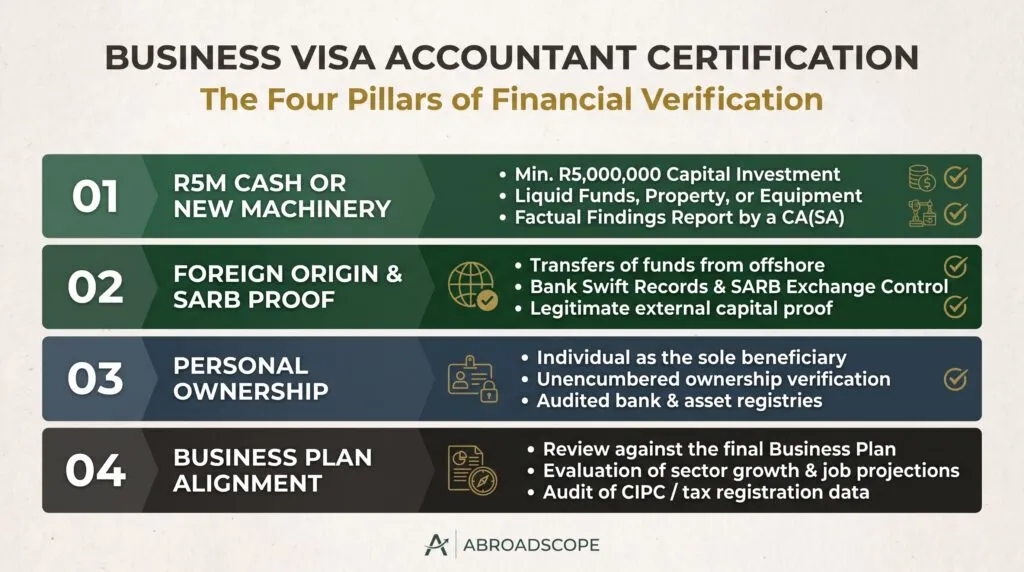
Whether you are launching a brand-new company or acquiring an existing South African enterprise, the accountant’s Factual Findings Report must verify four core statutory pillars:
1. The Minimum R5 Million Threshold (Cash or Cash + New Machinery)
Under Government Notice 560, the accountant must confirm that at least R5,000,000 is available to be invested—or has already been invested—to form part of the intended book value of the South African business. This contribution must consist of:
- Cash (at least R5 million); or
- A combined cash and capital contribution totalling at least R5 million, where the non-cash portion consists strictly of new machinery or equipment imported or acquired for the operations of the enterprise.
(Note: If you hold an approved DTIC/DHA national-interest capital waiver reducing the R5 million threshold, the accountant certifies the exact reduced amount specified in your waiver.)
2. Foreign Origin of the Capital
The Regulations require that the qualifying financial contribution originate from outside South Africa. Funds earned locally inside South Africa—or borrowed from a South African commercial bank—do not qualify.
To verify foreign origin, your accountant will inspect your offshore bank account statements (often covering up to three years of banking history where required to establish source of funds), legal ownership of the offshore account, and—where funds have already been remitted—inward South African Reserve Bank (SARB) foreign exchange payment records and “non-resident” endorsed share certificates.
3. Personal Ownership & Unencumbered Availability
If the capital has not yet been transferred into South Africa, the accountant must confirm the exact account holder details, branch information, and clear availability of the funds for transfer into the South African venture. As a critical practical rule, the DTIC routinely rejects applications where the R5 million sits in a third-party account or inside a foreign holding company rather than in the applicant’s personal name.
4. Exact Alignment with Your Business Plan
One of the fastest ways to trigger a technical refusal on the DTIC VRS portal is internal inconsistency. The exact Rand figure, cash-versus-equipment split, and deployment schedule stated in your accountant’s Factual Findings Report must match your business plan’s financial projections to the cent.
What Documents Will Your Accountant Request?
The evidence your accountant must collect and retain in their working file differs depending on whether your business is new or already operating:
| Verification Category | Establishing a New Business | Investing in an Existing Business |
| Entity & Ownership | Signed visa form, proposed business profile, director/shareholder structure, and CIPC registration (if formed). | CIPC registration certificate, share certificates, partnership/sale agreements, and director/owner details. |
| Financial & Bank Proof | Offshore bank account details, confirmation of legal account owner, and historical bank statements proving origin and availability. | Audited financial statements for the preceding financial year, tax clearance status, and proof of completed foreign investment transfers. |
| Non-Cash Capital (If Used) | Signed purchase contracts, invoices, and import/customs records proving machinery/equipment is new. | Purchase contracts, asset register updates, and certified net-asset valuations from a registered valuer. |
Does Buying Property in South Africa Qualify for a Business Visa?
No. This is one of the most persistent myths in South African investor immigration.
Simply purchasing a R5 million residential home, holiday villa, or passive buy-to-let apartment in Cape Town or Johannesburg never qualifies you for a Section 15 Business Visa—and no compliant SAICA, SAIPA, or CIBA accountant can certify passive personal real estate as a qualifying business capital contribution.
To qualify, your capital must be deployed into an active, operating commercial enterprise in which you are personally employed or actively involved in management, and which meets the DTIC’s feasibility, national-interest, and 60% permanent South African staff requirements. (If your goal is residency backed by personal real estate and global wealth without running an active company, South Africa’s Financially Independent Permit under Section 27(f) is the correct legal pathway.)
Don’t Forget the 24-Month Accountant Compliance Renewal
Your relationship with your South African accountant does not end when your initial Business Visa is approved.
Under Section 15 of the Immigration Act, you are legally required to submit fresh proof to Home Affairs within 24 months of visa issuance—and every two years thereafter—confirming that your R5 million capital contribution remains actively invested in the business. That ongoing compliance proof requires an updated accountant’s verification backed by your company’s current financial statements. Similarly, if you transition to Section 27(c) Business Permanent Residence, your permit remains subject to ongoing investment verification at the two-year and five-year marks.
Get Your Capital Verification Right the First Time
An accountant’s Factual Findings Report sits at the intersection of South African accounting standards, SARB exchange control rules, and Department of Home Affairs regulations. Using an accountant who is unfamiliar with the Immigration Act—or whose report contradicts your DTIC business plan—can cost you months in avoidable rejections.
At Abroadscope, we coordinate directly with specialist SAICA- and SAIPA-registered immigration accountants on your behalf. We verify your offshore capital structure before funds move, align your Factual Findings Report and Representation Letter seamlessly with your DTIC business plan, and manage your entire Business Visa submission from VRS upload to final approval.
Preparing your capital for a South African Business Visa? Book a confidential consultation with Abroadscope today to ensure your accountant’s certificate and investment structure are built for first-time approval.

