Unlike Thailand, Malaysia, or Panama—which strictly lock their retirement visas behind a minimum age of 50 or 55—South Africa has long been an outlier for the global FIRE (Financial Independence, Retire Early) community. Under current South African law, there is no South Africa retirement visa age limit.
That single legal quirk allowed financially independent founders, exited tech entrepreneurs, and passive-income investors in their 30s and 40s to relocate to Cape Town or the Garden Route on a four-year Section 20 Retired Person Visa simply by proving R37,000 per month in passive income.
In 2026, however, that window is narrowing fast. Following Cabinet’s approval of the Revised White Paper on Citizenship, Immigration, and Refugee Protection in April 2026, the Department of Home Affairs (DHA) has formally proposed introducing a minimum age of 55 alongside a higher monthly income threshold. Even before Parliament enacts those changes, adjudicators are already applying far stricter scrutiny to younger applicants. Here is what is law today, what is proposed, and how under-55 applicants can still qualify cleanly.
Table of Contents
- Is There a South Africa Retirement Visa Age Limit in 2026?
- What Is Law vs. Proposed Under the 2026 White Paper?
- Why DHA Scrutinizes Applicants Under 55
- How to Structure Bulletproof Passive Income If You Are Under 55
- 3 Better Alternatives If You Are Still Working or Running a Business
- Why Timing Matters for Early Retirees
- Protect Your Early Retirement Application With Abroadscope
Is There a South Africa Retirement Visa Age Limit in 2026?
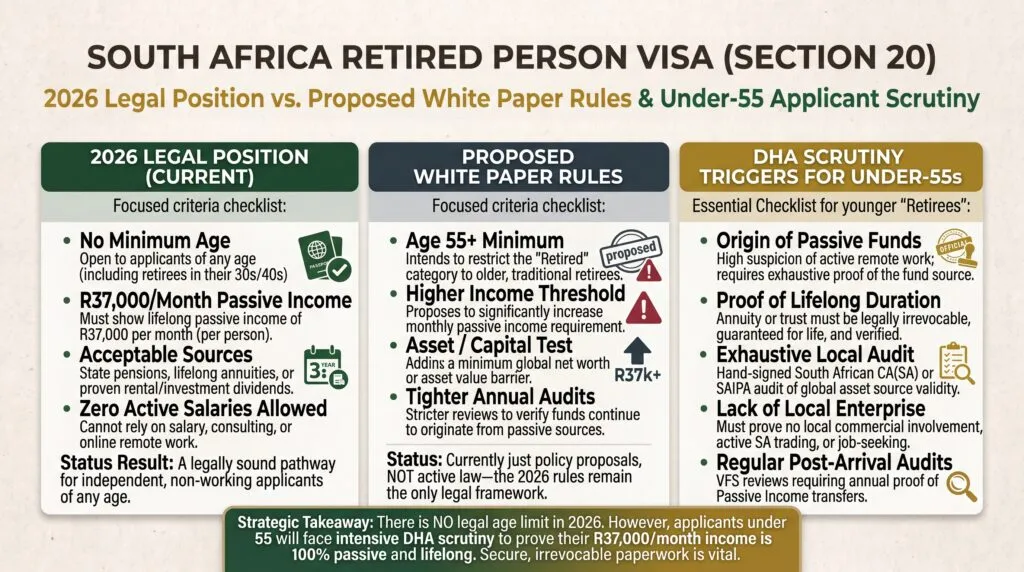
No—not under current law. Section 20 of the Immigration Act 13 of 2002, administered by the Department of Home Affairs, sets zero minimum age requirement for either the 4-year Temporary Retired Person Visa or direct Permanent Residence under Section 27(e).
Legally, eligibility rests entirely on financial self-sufficiency and genuine retirement intent—specifically proving at least R37,000 per month in qualifying passive income (or net worth generating that income) without taking up employment in South Africa. A 38-year-old with R45,000/month in verified rental leases or irrevocable annuity payouts qualifies under the exact same statutory section as a 68-year-old pensioner.
What Is Law vs. Proposed Under the 2026 White Paper?
Much of the confusion online stems from headlines treating government policy proposals as enacted law. In April 2026, South Africa’s Cabinet approved the Revised White Paper on Citizenship, Immigration, and Refugee Protection, which directly targets the Retired Person Visa for reform.
Here is the exact legal position today:
| Policy Area | Current Law (In Force Now) | 2026 Revised White Paper (Proposed Only) |
| Minimum Age | None (open to any adult age) | Minimum age of 55 (with narrow exceptional waivers) |
| Monthly Income Threshold | R37,000/month (unchanged since 2014) | Significantly higher threshold aligned with cost of living |
| Legal Status | Active & enforceable for all current filings | Policy proposal only — requires Parliamentary legislation |
Why this matters right now: Applications are adjudicated strictly under the law in force on the date you submit—and the White Paper does not propose applying a new South Africa retirement visa age limit retrospectively. For financially independent individuals under 55, the current rules remain open, but the window is finite.
Why DHA Scrutinizes Applicants Under 55
Even though no statutory South Africa retirement visa age limit has been enacted yet, submitting a weak application in your 20s, 30s, or 40s is far riskier today than it was three years ago.
Why? Because industry data indicates that roughly two-thirds of recent Retired Person Visa applicants have been under 55—including remote workers, freelancers, and digital nomads attempting to use the Retirement Visa as a cheap workaround to avoid work visa rules.
Home Affairs adjudicators are actively watching for disguised employment. If you are under 55, your file will face heightened scrutiny on three fronts:
- Source of Funds: Adjudicators look closely at bank statements to spot recurring corporate payroll deposits, consulting retainers, or freelance client invoices disguised as “passive income.”
- Durability of Income: Because you do not yet draw a government state pension, DHA checks whether your rental leases, dividends, or annuities are genuinely sustainable for the full four-year visa period.
- Genuine Non-Work Intent: A Retired Person Visa strictly prohibits local employment or operating a South African business. Any hint that you plan to work locally triggers an immediate refusal.
How to Structure Bulletproof Passive Income If You Are Under 55
If you are genuinely retired early and applying before a South Africa retirement visa age limit takes effect, your financial documentation must leave zero room for doubt.
Follow four compliance rules when assembling your South Africa retirement visa R37000 proof:
- Prioritise Irrevocable Annuities or Verified Rentals: An irrevocable annuity paying R37,000+/month—or multiple properties backed by certified title deeds, signed leases, and 6–12 months of matching bank deposits—carries far greater weight than volatile stock dividends alone.
- Include a Chartered Accountant (
CA(SA)) Certificate: When you are under 55 and combining multiple passive streams (such as rentals plus investment distributions), commissioning a SAICA-registered South African Chartered Accountant to certify your monthly passive yield removes ambiguity for the adjudicator. - Build a Currency Buffer: Aim for R42,000+ per month in ZAR equivalent so exchange-rate swings never drop your income below R37,000 during processing.
- Keep Active Income Completely Separate: Never submit bank statements containing active salary or consulting payments alongside your passive income proof.
(Note: If your goal is direct South Africa retirement permanent residence under Section 27(e), remember that your R37,000/month must be guaranteed for life—which is difficult for younger applicants unless structured through an irrevocable lifetime annuity.)
3 Better Alternatives If You Are Still Working or Running a Business
If you are under 55 and still actively earning a salary or building a company, do not force a Retirement Visa application. South Africa offers three far cleaner legal pathways tailored to younger, active profiles:
- Remote Work Visitor Visa (Digital Nomad Visa): If you are employed by an offshore company and earn at least R650,976 gross per annum, this visa lets you live in South Africa for up to 3 years while working remotely—legally and transparently. Compare your options in our South Africa Remote Work Visa vs. Business Visa guide.
- Financially Independent Permit (Section 27(f)): If you have had a liquidity event or built a global net worth of R12 million or more, you can bypass the Retirement Visa completely. Section 27(f) has no age limit, requires zero monthly income proof, and grants direct Permanent Residence with full freedom to work or launch a company. See which assets qualify in our R12 million net worth South Africa visa guide.
- Section 15 Business Visa: If you plan to launch or acquire a South African enterprise with R5 million in foreign capital, the Business Visa grants full local operating rights and a direct path to Permanent Residence.
Why Timing Matters for Early Retirees
Because the April 2026 White Paper signals clear government intent to introduce a 55+ minimum age and raise the R37,000 financial threshold once legislative amendments pass, early retirees who already meet the current passive-income rules should not wait indefinitely.
If you are relocating with a spouse or life partner, make sure you also plan your accompanying family structure and foreign pension tax position early—topics we break down in our guide to retiring in South Africa with a spouse and foreign pension tax.
Protect Your Early Retirement Application With Abroadscope
Navigating the South Africa retirement visa age limit debate in 2026 requires more than filling out Form DHA-1738. For applicants under 55, approval comes down to proving beyond doubt that your income is genuinely passive, verifiable, and structured to withstand heightened Home Affairs scrutiny.
At Abroadscope, we assess early-retirement portfolios honestly from day one. We audit your passive income streams, coordinate SAICA-registered Chartered Accountant certifications, and—where a Remote Work Visa or Financially Independent Permit is a safer strategic fit—guide you onto the right pathway before you apply.
Planning to retire early in South Africa before new age rules take effect? Book a confidential Retirement Residency Assessment with Abroadscope today.

