
Relocating to South Africa for retirement is rarely a solo decision. Most international retirees moving to Cape Town, the Winelands, or the Garden Route are planning the transition as a couple—and quickly discover that retiring in South Africa with spouse visa rules involves far more than adding a second name to an application form.
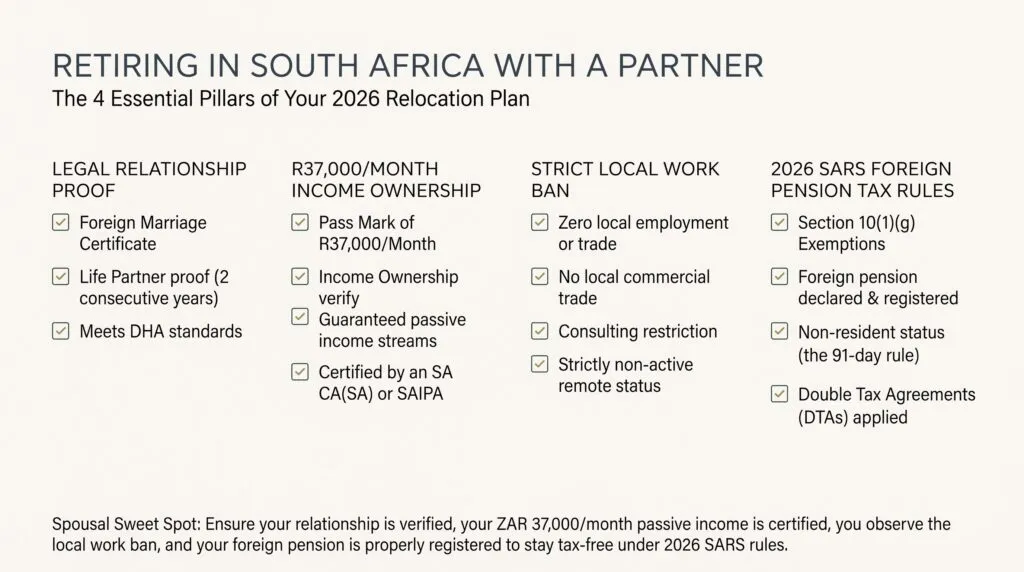
Between proving a two-year permanent life partnership, structuring your R37,000/month passive income in the right spouse’s name, navigating strict local work prohibitions, and adapting to South Africa’s major March 2026 foreign pension tax changes, couples who plan both immigration and tax together avoid costly surprises. Here is your complete 2026 guide to retiring in South Africa with a spouse or life partner.

[Rank Math SEO Block: Insert Table of Contents Plugin Here]
- How Accompanying Spouses & Life Partners Qualify
- The 2-Year Life Partner Proof Rule (Unmarried Couples)
- Financial Structuring: Does R37,000/Month Cover Both Partners?
- Strict Work Bans & School-Age Children Rules
- Foreign Pension Tax in South Africa: The Major 1 March 2026 Change
- How Couples Manage SARS Tax Residency & Double Taxation Agreements
- Plan Your Couple’s Relocation Smoothly With Abroadscope
How Accompanying Spouses & Life Partners Qualify
When the main applicant qualifies for a Section 20 Temporary Retired Person Visa (valid for up to 4 years, renewable) or direct Section 27(e) Retirement Permanent Residence, their immediate family can join them in South Africa.
Under the Immigration Act administered by the Department of Home Affairs, each accompanying family member submits their own linked application:
- Legally Married Spouses: Supported by an official, apostilled/legalised unabridged marriage certificate (plus divorce decrees or death certificates from any prior marriages).
- Permanent Life Partners (Unmarried Couples): South African immigration law recognises both opposite-sex and same-sex permanent life partners—provided you clear the statutory two-year cohabitation and financial interdependence test.
The 2-Year Life Partner Proof Rule (Unmarried Couples)
If you are retiring in South Africa with spouse visa arrangements as an unmarried couple, Home Affairs does not take your relationship on trust. You must prove that you have been in a genuine, exclusive permanent life partnership for at least two years prior to applying.
To pass DHA adjudication cleanly, unmarried couples must submit:
- A Notarial Life Partnership Agreement: Formally executed and signed by both partners, confirming mutual emotional and financial support.
- Proof of Shared Residence (2+ Years): Joint lease agreements, shared property title deeds, or municipal utility bills addressed to both partners at the same residential address over the preceding 24 months.
- Proof of Financial Interdependence: Joint bank accounts, shared insurance policies, mutual beneficiary nominations, or regular financial transfers demonstrating a shared household.
- Supporting Affidavits: Confirming the permanence and exclusivity of the relationship.
Financial Structuring: Does R37,000/Month Cover Both Partners?
One of the most common places couples’ applications come apart is whose name the passive income sits in.
The core R37,000 per month passive income threshold is assessed per qualifying applicant. If one partner holds a pension or irrevocable annuity paying R37,000+/month in their own name—plus additional verifiable means to financially support their accompanying spouse—the second partner can apply as an accompanying spouse/dependent without needing a separate R37,000/month pension of their own.
However, if a couple’s pensions are split (for example, Partner A earns R22,000/month and Partner B earns R20,000/month), neither individual clears R37,000/month on their own. Before lodging, you must structure your South Africa retirement visa R37000 proof carefully—often by consolidating qualifying passive rental or investment income, or commissioning a Chartered Accountant (CA(SA)) certificate—so the main applicant clearly clears the statutory threshold.
| Couple Scenario | Best Visa Structure | Key Compliance Check |
| One partner earns R37,000+/mo | Main applicant on Section 20/27(e) + Accompanying Spouse | Prove financial support for the accompanying spouse |
| Both partners earn R37,000+/mo | Two independent Retirement Visas (or Main + Spouse) | Independent visas protect both partners if circumstances change |
| Combined global net worth ≥ R12M | Financially Independent Permit (Section 27(f)) | Grants direct PR for the family with one R120,000 fee upon approval |
(If your household net worth exceeds R12 million, compare both routes in our guide to the R12 million net worth South Africa visa and Financially Independent Permit cost South Africa.)
Strict Work Bans & School-Age Children Rules
Understanding the activity limits of retiring in South Africa with spouse visa status prevents serious immigration breaches:
- No Local Work or Business Activity: Neither the main Temporary Retirement Visa holder nor an accompanying spouse is permitted to take up local employment, consult for South African clients, or operate a local business in South Africa. (Note: Once you upgrade to South Africa retirement permanent residence under Section 27(e), the work ban lifts completely.)
- Minor Children Require Study Visas: Dependent minor children may accompany you to South Africa, but any school-age child attending a South African primary or high school must hold a separate Study Visa—an accompanying visitor endorsement does not authorise schooling.
- Age Scrutiny for Younger Couples: If you and your partner are retiring early in your 30s or 40s, factor in heightened DHA vetting and the April 2026 White Paper proposals detailed in our South Africa retirement visa age limit guide.
Foreign Pension Tax in South Africa: The Major 1 March 2026 Change
For decades, foreign retirees moving to South Africa relied on Section 10(1)(gC)(ii) of the Income Tax Act—a blanket exemption that shielded foreign private pensions, annuities, and retirement lump sums (earned for past employment outside South Africa) from South African income tax.
That exemption is now gone. Under the Taxation Laws Amendment Act 2025, Section 10(1)(gC)(ii) was deleted effective 1 March 2026.
Here is what foreign retirees must know for the 2026/2027 tax year and beyond:
- Private Foreign Pensions & Annuities: If you become a South African tax resident, private foreign pensions, occupational pensions, and foreign retirement annuities received from 1 March 2026 onward are now taxable in South Africa at standard marginal rates (18% to 45%), unless specifically protected by a Double Taxation Agreement (DTA).
- Foreign State Pensions (Social Security): Crucially, the separate exemption for foreign social security systems (such as the UK State Pension or US Social Security) was not removed.
- Foreign Tax Credits: Where a foreign pension is taxed both abroad and in South Africa, South African tax residents can claim foreign tax credits under Section 6quat—or rely on DTA taxing-right allocations—to avoid double taxation.
How Couples Manage SARS Tax Residency & Double Taxation Agreements
The 1 March 2026 rule change only applies if you become a South African tax resident with the South African Revenue Service (SARS). Holding a South African Retirement Visa does not automatically make you a tax resident.
You only cross into South African tax residency if you either:
- Become ordinarily resident in South Africa (making South Africa your true, permanent home); or
- Trigger the Physical Presence Test (spending more than 91 days in South Africa in the current tax year, more than 91 days in each of the five preceding tax years, and more than 915 days in total over those five years).
Two practical strategies for retiring couples:
- Seasonal “Swallow” Retirees: If you split your year between Europe/UK and Cape Town—maintaining your primary home abroad and staying under 91 days per South African tax year—you generally remain a non-resident for tax purposes, keeping your foreign private pensions outside the SARS tax net. (Read our full breakdown of the 91/91/915 rule in our South Africa Plan B residency and tax rules guide.)
- Full-Time Relocating Retirees: If you plan to live in South Africa permanently, engage a cross-border South African tax specialist before moving to review the exact pension article in your home country’s Double Taxation Agreement (DTA) with South Africa and register cleanly on SARS eFiling.
Plan Your Couple’s Relocation Smoothly With Abroadscope
Retiring in South Africa with spouse visa rules is completely achievable when your relationship proof, passive income ownership, and 2026 tax residency strategy are aligned from day one.
At Abroadscope, we guide international couples through every step of South African retirement immigration—from drafting compliant two-year life partner dossiers and structuring R37,000/month Chartered Accountant certifications to coordinating Section 20 temporary visas, Section 27(e) Permanent Residence, and trusted cross-border tax referrals.
Planning your retirement move to South Africa with your spouse or partner? Book a confidential Couples Retirement Residency Assessment with Abroadscope today.

