
When a South African manufacturing plant needs a German commissioning engineer on site next month, or a multinational bank needs a London-based auditor to run a six-week systems rollout in Johannesburg, waiting months for a General or Critical Skills Work Visa is commercially impossible.
For these urgent, time-bound deployments, South African immigration law provides a dedicated mechanism: the Section 11(2) Visitor’s Visa with Authorisation to Conduct Work—commonly referred to as the Section 11(2) Short-Term Work Visa.
While widely used across engineering, energy, mining, IT, and film production, Section 11(2) is also one of the most misunderstood—and increasingly scrutinised—permit categories in South Africa. In 2026, South African Missions abroad have tightened adjudication on repeat applications and poorly motivated assignments, catching multinational HR teams off guard. Here is everything corporate mobility managers and foreign specialists need to know to secure a Section 11(2) authorisation cleanly and compliantly.

What Is a Section 11(2) Visa in South Africa?
Technically, a Section 11(2) is not a traditional long-term work visa. It is a Visitor’s Visa issued under Section 11(1)(a) of the Immigration Act carrying a specific Section 11(2) endorsement authorising the holder to conduct defined, short-term work activities in South Africa for a maximum initial period of 90 days.
Because it is anchored to a short-term assignment, it bypasses the lengthy 100-point work visa matrix, SAQA qualification evaluations, and Department of Employment and Labour certificates required for long-term work permits. However, it comes with strict boundaries:
- It must be applied for before travelling: Even if you hold a visa-exempt passport (such as UK, EU, US, or Australian citizenship), you cannot fly into South Africa as a tourist and start working—nor can you convert a standard visitor visa into a Section 11(2) inside the country. You must obtain the Section 11(2) endorsement at the South African Mission or VFS centre in your country of residence before boarding your flight.
- It is tied strictly to one scope and host: The authorisation only permits you to perform the exact duties at the exact South African host site specified in your application.
Who Qualifies for a Section 11(2) Short-Term Work Visa?
Section 11(2) is designed for foreign specialists who remain employed abroad and are deployed to South Africa to fulfil a specific, urgent, or project-bound obligation. Common qualifying scenarios include:
- Technical & Engineering Specialists: Commissioning machinery, installing specialised equipment, or performing warranty repairs and maintenance.
- Corporate Trainers & Subject-Matter Experts: Conducting intensive internal training, knowledge transfer, or software implementation for a South African subsidiary or client.
- Auditors & Management Consultants: Executing defined short-term corporate audits, due diligence, or turnaround projects.
- Film, Media & Entertainment Crews: Foreign cast, directors, and technical crew entering for commercial shoots or international productions.
When Section 11(2) Is NOT Appropriate
A major compliance mistake is treating Section 11(2) as a fast-track bridge for permanent hiring. You should not use Section 11(2) if:
- The foreign national is filling an ongoing, permanent operational role in South Africa.
- The individual is an independent freelancer looking to work remotely or pick up local ad-hoc clients.
- The assignment is open-ended project management with no clear completion date.
The 180-Day Cap & 2026 Mission Scrutiny (Directive 1 of 2019)
Under Directive 1 of 2019, the Department of Home Affairs capped how long a foreign national can rely on Section 11(2) in a single year:
- Initial Grant: Up to 90 days, issued by the South African Mission abroad.
- One In-Country Extension: If a project runs over schedule, the visa holder may apply once per calendar year via VFS Global inside South Africa for an extension of up to an additional 90 days—bringing the practical ceiling to 180 days in a calendar year.
- No Back-to-Back Applications: Once a specialist has used an initial 90-day grant and a 90-day extension in the same calendar year, they cannot simply fly home and apply for another Section 11(2) at the Mission in that same year.
Why 2026 adjudication is tougher: Throughout 2026, corporate immigration practitioners have flagged heightened scrutiny at South African Missions abroad. Consular officers are increasingly rejecting Section 11(2) applications where the motivation letter looks like disguised ongoing employment, where the host company fails to prove why specialised foreign skills are needed, or where the same specialist has a history of repeated Section 11(2) entries. If a major infrastructure, mining, or energy project realistically requires more than six months on the ground, planning an Intra-Company Transfer (ICT) or Critical Skills / General Work Visa early is far safer than gambling on repeat Section 11(2) filings.
Complete Section 11(2) Document Checklist
A fast Section 11(2) approval depends on clean, consistent documentation from both the applicant and the South African host entity.
From the Applicant & Foreign Employer
- Form DHA-84: Fully completed and signed in black ink only.
- Valid Machine-Readable Passport: Valid for at least 30 days beyond the intended departure date, with at least two to three completely blank visa pages (manually extended passports are not accepted).
- Two Recent Passport Photographs: Colour, 45mm x 35mm, compliant with DHA specifications.
- Curriculum Vitae (CV) & Qualifications: Demonstrating the specialised skills and experience required for the assignment.
- Proof of Financial Means: Typically 3 months of recent, certified bank statements (plus proof of remuneration or stipend from the employer).
- Preliminary Flight Itinerary & Accommodation: Return flight reservation (preliminary booking only—do not pay for non-refundable flights before approval) and South African hotel or residential address.
- Yellow Fever Certificate: Required only if travelling from or transiting through a Yellow Fever endemic belt.
- Foreign Employer Letter: Confirming ongoing employment abroad, remuneration, and the temporary secondment to South Africa.
From the South African Host Company (The Motivation Letter)
The South African host entity must issue a formal, stamped motivation letter on company letterhead—supported by its CIPC registration, SARS registration, and a certified ID copy of the authorised signatory—explicitly confirming:
- Purpose & Necessity of the Work: Why the project requires this specific foreign specialist.
- Exact Nature of the Duties: Clear, project-bound scope of work.
- Required Qualifications & Skills: Matching the applicant’s CV.
- Place of Work: Physical South African site address(es).
- Duration of Assignment: Exact start and end dates (within the 90-day limit).
- Remuneration Details: Confirmation of who is paying the applicant (foreign employer vs. local stipend).
- Host Company Accountability: Full contact details of the responsible local representative.
How Long Does a Section 11(2) Visa Take to Process?
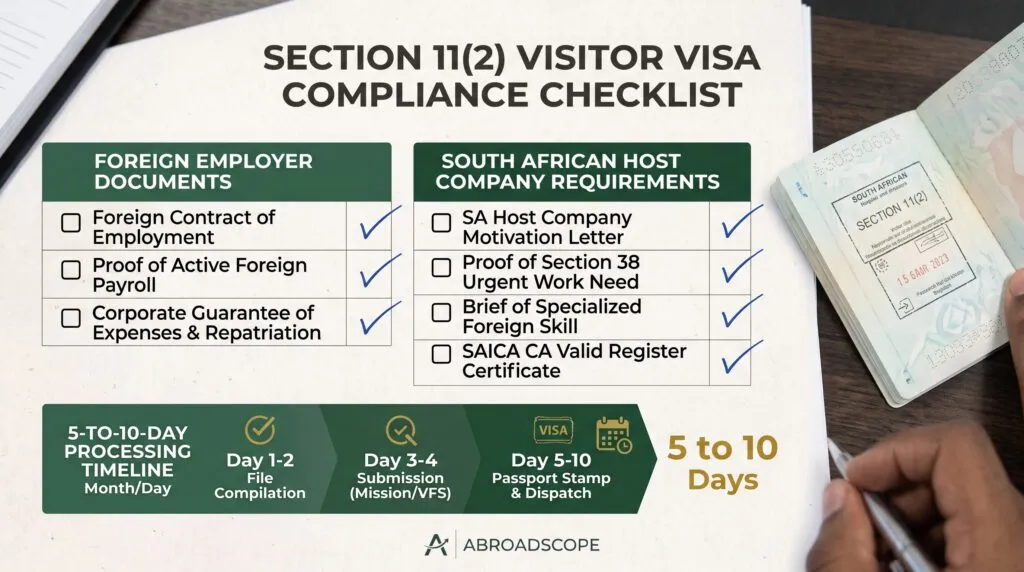
One of the primary advantages of Section 11(2) is speed. At most South African Diplomatic Missions and VFS Global centres abroad, standard processing takes 5 to 10 working days (though peak seasonal volumes or consular queries can extend this slightly).
Practical planning tip: Most Missions allow you to lodge your application one to two months prior to your intended travel date, and remember that your original passport is retained by the Mission during adjudication. Also note that if you need to extend your Section 11(2) inside South Africa via VFS Global, you should file well before your initial 90 days expire—and factor in that accompanying spouses or children do not receive automatic work or study rights and must hold their own appropriate visas.
Deploy Your Specialists to South Africa Without Project Delays
In 2026, a generic two-paragraph invitation letter is no longer enough to clear a Section 11(2) application at a South African Mission. One vague job description—or an accidental breach of the 180-day calendar-year cap—can leave a critical engineer stranded offshore while your project sits idle.
At Abroadscope, we partner with HR directors, project managers, and multinational corporations to manage urgent Section 11(2) deployments end to end. We draft compliant South African host motivation letters, audit foreign employer packs before Mission lodgement, coordinate in-country VFS extensions, and advise when a project needs to transition onto an Intra-Company Transfer or points-based Work Visa.
Deploying foreign specialists to South Africa on a tight project deadline? Contact Abroadscope today for a rapid Section 11(2) eligibility and compliance check.

