
Acquiring an established South African company—whether a profitable Cape Town guesthouse, a manufacturing SME, or a regional franchise—often looks far safer than building a startup from scratch. You step into existing revenue, proven supplier relationships, and an operational team on day one.
From an immigration perspective, however, buying an existing business in South Africa carries stricter upfront proof requirements than launching a new one. When you start a brand-new company, the Department of Home Affairs (DHA) and the Department of Trade, Industry and Competition (the dtic) allow you to submit signed undertakings promising to register with statutory bodies and hire local staff later. When you buy an established enterprise, you inherit its entire compliance history immediately.
If the seller has messy financial statements, lapsed tax registrations, or a workforce that falls short of South Africa’s 60% local hiring quota, your Business Visa can be refused before you ever take the keys. Here is the complete visa and legal checklist foreign buyers must run through before signing a Sale of Business or Sale of Shares Agreement.

Can a Foreigner Buy a Business in South Africa Without a Visa?
Yes—ownership and immigration are legally separate. South African company law places no general restriction on foreign nationals owning 100% of a South African private company (Pty Ltd).
Whether you need a visa depends entirely on how you plan to operate the business:
- Passive or Offshore Ownership: If you intend to own the shares from abroad while a South African citizen, permanent resident, or properly authorised manager runs day-to-day operations, you do not need a Business Visa. Standard exchange control, company law, and tax rules still apply.
- Hands-On Management in South Africa: If you plan to relocate to South Africa to manage, direct, or work in the business yourself, you must hold a Section 15 Business Visa (or another visa category that grants the legal right to work).
Crucially, a Section 15 Business Visa is tied strictly to the specific enterprise named in your application. It authorises you to live in South Africa and work in that company, but it does not grant general work rights across other employers. Also note that an accompanying spouse visa does not automatically carry work, study, or business rights of its own.
Step 1: Structure the R5 Million Acquisition & Exchange Control Properly
Under Section 15(1) of the Immigration Act, investing in an existing business requires a minimum capital contribution of R5,000,000 originating from outside South Africa. This contribution can be in cash or a combination of cash and qualifying foreign-sourced machinery or equipment brought into South Africa for the business.
Before transferring a single Rand, align your deal structure with both DHA regulations and South African Reserve Bank (SARB) exchange control rules:
- Shares vs. Shareholder Loan: If you inject the R5 million as a loan from yourself to the South African company rather than subscribing for shares, that inward foreign loan requires prior written approval from the South African Reserve Bank under Section G(C)(i) of the Currency and Exchanges Manual (arranged through your South African bank).
- Make the Sale Conditional on Your Visa: Never sign an unconditional purchase agreement that locks up your capital before immigration clearance. In a private acquisition, instruct your commercial attorney to include a suspensive condition making the sale conditional upon the grant of your Business Visa by a defined long-stop date.
- Verify Your Sector Is Permitted: Regardless of purchase price or profitability, DHA regulations outright bar Business Visas for three sectors: importing second-hand motor vehicles for export, the exotic entertainment industry, and the private security industry.
Step 2: Run Immigration Due Diligence on the Seller’s Business
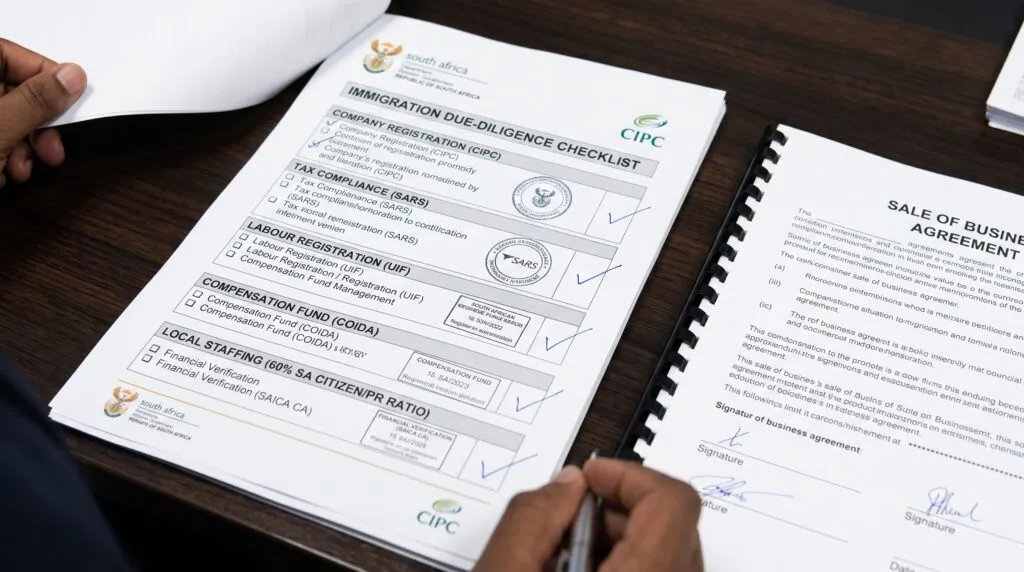
Standard commercial due diligence checks revenue, leases, and customer contracts. For a foreign buyer, immigration due diligence is equally non-negotiable—because applying with an existing business that has compliance gaps or incomplete financials is a leading cause of Business Visa refusals.
Before you commit to the purchase, demand the following from the seller:
1. The 60% South African Permanent Staff Audit
You must provide proof that at least 60% of the total staff complement employed in the operations of the business are South African citizens or permanent residents holding permanent positions. Ask the seller upfront for a complete staff register broken down by role, contract type, and citizenship or permanent residence status. If the business relies heavily on casual contractors or foreign nationals without permanent residency, the acquisition will fail the 60% test unless restructured before submission.
2. Full Statutory Registrations (No Undertakings Allowed)
Unlike a brand-new venture, an existing business must submit actual proof of registration with every mandatory South African authority:
- CIPC (Companies and Intellectual Property Commission), where legally required
- SARS (South African Revenue Service — active tax registration and compliance)
- UIF (Unemployment Insurance Fund)
- COIDA (Compensation Fund for Occupational Injuries and Diseases)
- SAQA-Recognised Professional Body, Board, or Council, where your specific industry requires regulated licensing
3. Prior Financial Statements & Trading History
To prove the business is a genuine, viable going concern, you must submit financial statements for the preceding financial year alongside verifiable trading history. If the seller has been running cash off the books or has uncompiled accounts, the DTIC will not endorse the venture’s commercial feasibility.
Step 3: Commission the Chartered Accountant’s Report & DTIC VRS Filing
Once due diligence clears and your acquisition terms are agreed, your immigration file moves into two critical verification phases:
- Accountant’s Certificate / Factual Finding Report: A South African accountant registered with SAICA, SAIPA, or CIBA must issue a formal certificate confirming that at least R5,000,000 originating from abroad is available to be invested—or has already been invested—into the existing business. Where physical equipment or machinery is part of the contribution, the accountant will verify purchase receipts, vehicle or asset registrations, import documentation, and an updated asset register.
- DTIC Recommendation via the VRS Portal: You must apply online through the DTIC’s Visa Recommendation System (VRS) for a formal Letter of Recommendation confirming both the commercial feasibility of the acquired business and its contribution to South Africa’s national interest.
Step 4: Compile Your Complete Section 15 Visa Application Pack
Only after you receive the positive DTIC recommendation letter should you finalize your personal DHA submission. Order your police clearance certificates last, as they must be less than six months old on the date of lodgement.
Your complete submission at the South African Mission in your country of residence (or via VFS Global where eligible) must include:
- Form DHA-1738: Duly completed and signed in black ink.
- Valid Machine-Readable Passport: Valid for at least 30 days after the intended expiry of your stay, with at least two to three completely blank visa pages.
- Personal Clearances & Medicals: Medical report on prescribed Form DHA-811 (less than 6 months old), full police clearance certificates from every country where you have resided for 12+ months, and a Yellow Fever certificate if traveling through an endemic belt.
- Existing Business Proof Pack: Prior-year financial statements, proof of investment (sale agreement, bank transfer confirmations, foreign exchange records, or asset register), statutory registrations (CIPC, SARS, UIF, COIDA), and proof of the 60% South African permanent staff complement.
- DTIC Recommendation Letter & SAICA/SAIPA/CIBA Accountant Certificate.
Step 5: Protect Your Visa After Takeover (Ongoing Compliance Deadlines)
A South African Business Visa is typically issued for up to three years at a time (Regulation 14(5)), and Home Affairs treats it as a conditional grant. If the business stops trading, pivots into an unauthorised industry, or falls out of statutory compliance, those gaps will surface at renewal.
Mark three mandatory compliance milestones in your corporate calendar from day one:
- Within 12 Months of Issuance: Submit formal proof from the Department of Employment and Labour confirming that at least 60% of your permanent staff are South African citizens or permanent residents.
- Within 24 Months (and Every Two Years Thereafter): Prove to Home Affairs under Section 15 that your R5 million capital contribution remains actively invested in the business. (Note: If you later transition to Business-based Permanent Residence under Section 27(c), that permit also requires proof of ongoing investment two years after issuance and three years after that.)
- At Least 60 Days Before Expiry: Lodge your Business Visa renewal application in person in South Africa (Regulation 9(8)(c)), supported by a fresh South African police clearance and updated audited financial statements for the DTIC.
Acquire Your South African Business Without Immigration Surprises
Buying an operating business in South Africa is a high-stakes transaction where commercial law, exchange control, and immigration regulations intersect. A single oversight—such as wiring funds as an unapproved foreign shareholder loan or inheriting an unregistered payroll—can derail both your visa and your acquisition timeline.
At Abroadscope, we work alongside your commercial attorneys and SAICA-registered accountants before you sign the deal. We audit the target business’s immigration readiness, verify its 60% local staffing and statutory registrations, manage your DTIC VRS portal submission, and oversee your Section 15 Business Visa through to approval.
Evaluating a South African business acquisition? Book a confidential pre-acquisition immigration review with Abroadscope today to protect your capital and secure your residency.

