The headline requirement for a South African Section 15 Business Visa stops many capable foreign founders in their tracks: you must invest at least R5,000,000 in cash (or a combination of cash and new machinery or equipment) originating from outside South Africa.
For capital-light ventures—such as a software consultancy, a specialised BPO operation, a boutique creative studio, or an early-stage green-tech startup—injecting R5 million upfront can be commercially unnecessary. Fortunately, the Immigration Act provides a formal mechanism to reduce or waive that threshold.
What most online guides fail to tell you, however, is that a capital waiver is a discretionary exception, not a shortcut. In the 2025/26 financial year alone, parliamentary figures revealed that 57 Business Visa applications were rejected specifically for failing to meet the capital requirement—outnumbering the 33 Business Visas approved. Before you build your expansion timeline around a reduced investment, you need to understand which sectors qualify, which industries are completely barred, and the real-world processing delays a waiver introduces.

Can I Get a South African Business Visa with Less Than R5 Million?
Yes—legally, the Director-General of the Department of Home Affairs (DHA) has the statutory authority under Section 15 of the Immigration Act to reduce or waive the R5 million capitalisation requirement.
However, you cannot simply ask for a discount because R5 million is inconvenient. A capital reduction or waiver is only considered under two strict pathways:
- Your business operates in a gazetted National-Interest Sector listed under Government Notice 562 (GN 562 of 2014); or
- The Department of Trade, Industry and Competition (the dtic) explicitly requests a reduction or waiver on your behalf based on exceptional economic merit, job creation, or skills transfer.
Even when you qualify on paper, the process is two-tiered: the DTIC must first evaluate your business plan and formally recommend the reduced capital figure, and only then does DHA adjudicate your formal waiver request. Neither department is obliged to grant a 100% waiver; in practice, a well-motivated partial reduction (for example, investing R1.5 million to R2.5 million backed by strong local hiring) carries significantly higher credibility than requesting a zero-capital entry.
Which Industries Qualify for the R5 Million Capital Waiver in South Africa?
Under Government Notice 562 (published in Government Gazette 37837), South Africa identified strategic industries deemed to be in the national interest. If your commercial venture sits squarely within one of these categories, you have a statutory basis to motivate for a capital reduction:
| Sector Category | Examples of Qualifying Activities |
| BPO & IT-Enabled Services | Call centres, outsourced financial/legal processing, software development, and global tech support hubs. |
| Green Economy Industries | Renewable energy engineering, solar/wind installation manufacturing, waste-to-energy, and water-treatment tech. |
| Agro-Processing | Commercial food processing, specialty beverage production, and value-added agricultural exports. |
| Advanced Manufacturing | Medical devices, diagnostics, aerospace/satellite components, and industrial composites. |
| Tourism Infrastructure | Purpose-built tourism facilities, activity-based attractions, and heritage/museum developments (not passive residential rentals). |
| Creative & Design Industry | Film studios, treaty film co-productions, servicing foreign productions, commercial photography, and industrial design. |
| Automotive & Transport Equipment | Vehicle components, catalytic converters, electric drivetrain parts, and boatbuilding. |
| Heavy & Industrial Sectors | Chemicals, pharmaceuticals, plastic fabrication, electro-technical manufacturing, mineral beneficiation, oil and gas, and infrastructure development. |
| Light Manufacturing & Goods | Textiles, clothing and leather beneficiation (excluding fur), pulp, paper, furniture, and consumer goods. |
Strategic reality check: Merely slotting a generic consulting firm or retail shop under “IT-enabled services” or “consumer goods” will fail DTIC scrutiny. Your business plan must prove tangible economic spillover—such as export revenue, technology transfer, or high-volume South African job creation—that justifies waiving the standard R5 million commitment.
Which Businesses Are Barred from Getting a South African Business Visa?
Before investing time or legal fees into a business plan, verify that your industry is not prohibited. Under Government Notice 561 (GN 561 of 2014), the Minister of Home Affairs declared three specific business undertakings to be “undesirable”.
A Section 15 Business Visa—whether at the full R5 million threshold or under a waiver—will not be granted for:
- Importing second-hand motor vehicles into South Africa for the purpose of exporting them to other markets outside the Republic.
- The exotic entertainment industry.
- The private security industry.
(Note for corporate planners: If you are applying for a Corporate Visa rather than an individual Business Visa, a separate list under GN 563 also restricts the hospitality industry and fast-food outlets/franchises. Always confirm which statutory list applies to your permit class before signing a commercial lease.)
How Long Does a South Africa Business Visa Capital Waiver Take?
This is where most founders miscalculate their South African launch. Applying for a capital waiver adds an entire extra layer of government adjudication before you can even submit your Business Visa application.
Here is what the realistic end-to-end timeline looks like in 2026:
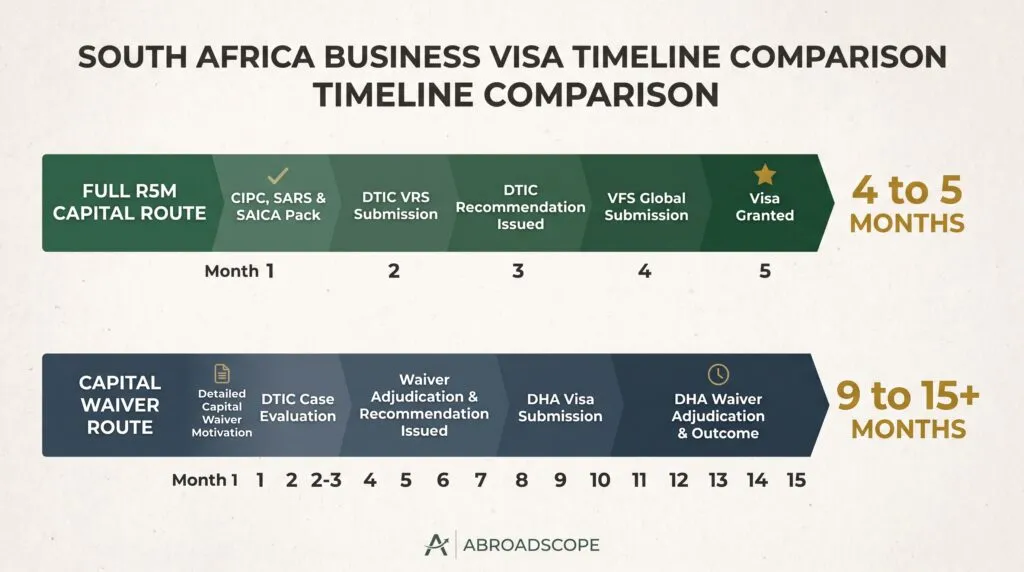
- Stage 1 — DTIC Capital Waiver Evaluation: Your business plan, financial projections, and national-interest motivation are submitted to the DTIC. While standard R5 million VRS portal recommendations target roughly 45 business days, capital waiver assessments routinely take 15 to 24 weeks due to deeper economic vetting.
- Stage 2 — DHA Waiver Adjudication: Once the DTIC issues its recommendation letter supporting the reduced capital, you lodge a formal waiver application with DHA. Home Affairs’ own published turnaround benchmark for waivers is 120 working days (with real-world outcomes typically falling between 8 and 16 weeks post-DTIC).
- Stage 3 — Substantive Section 15 Business Visa Filing: Only after you hold the signed DHA waiver letter in hand can you file your actual Business Visa application at a South African Mission abroad or VFS Global—adding another 8 to 12 weeks.
Total Capital Waiver Timeline: Expect 6 to 12 months just to clear the waiver stages, plus visa processing—meaning a realistic launch window of 9 to 15 months.
Capital Waiver vs. Full R5 Million vs. Alternative Pathways
Because a capital waiver is both time-intensive and discretionary, savvy founders compare all three strategic options before committing:
- Option A: Invest the Full R5 Million. If you have access to R5 million in personal offshore capital, committing the full threshold eliminates Stage 2 (the DHA waiver) completely. You move straight from the DTIC VRS recommendation into your Business Visa filing, cutting up to 6 months off your relocation timeline.
- Option B: Pursue the GN 562 Capital Waiver. Best suited for founders who are strictly operating in a high-priority national-interest sector (such as BPO, green energy, or advanced manufacturing), have a flexible 12-month launch horizon, and can present an institutional-grade business plan with strong local job creation.
- Option C: Pivot to a Different Visa Class. If you are an international founder running an offshore tech or consulting company with no immediate need to employ South African staff, South Africa’s Remote Work Visitor Visa (requiring a minimum gross annual income of R650,976 for up to 3 years) may let you live in Cape Town or Johannesburg legally without touching the R5 million requirement. Alternatively, ultra-high-net-worth founders with a global net worth of R12 million+ often bypass the Business Visa altogether via the Financially Independent Permit, which grants direct Permanent Residence with zero business-plan vetting or local hiring quotas.
Does a Capital Waiver Exempt Me from the 60% South African Staff Rule?
No. A common misconception is that a capital waiver relaxes all Business Visa conditions. It only reduces or waives the R5 million financial contribution.
Every other statutory obligation under Section 15 remains strictly enforceable:
- The 60% Local Workforce Mandate: You must still commit to employing at least 60% South African citizens or permanent residents in permanent positions, and submit formal proof from the Department of Employment and Labour within 12 months of visa issuance.
- Statutory Registrations: Your company must still register with CIPC, SARS, UIF, and COIDA.
- Accountant Certification: Whatever reduced capital figure the DTIC and DHA approve (for example, R2 million) must still originate from outside South Africa and be certified by a SAICA-, SAIPA-, or CIBA-registered accountant.
- 24-Month Compliance Proof: Under Section 15(4), you must still prove to DHA within 24 months (and every two years thereafter) that the approved capital contribution remains invested in the business.
Build a Waiver Strategy That Actually Passes Adjudication
A Business Visa capital waiver is not a form-filling exercise—it is an economic argument presented to two separate South African government departments. If your motivation does not clearly tie your venture to GN 562 national-interest priorities, or if your financial forecasts do not reconcile with your accountant’s certificate, you risk losing a full year to a refusal.
At Abroadscope, we advise foreign founders honestly from day one. We assess whether your venture genuinely qualifies for a GN 562 capital reduction, draft investor-grade DTIC and DHA waiver motivations, coordinate with SAICA-registered accountants, and—where a waiver isn’t the smartest commercial move—map faster alternative pathways into South Africa.
Planning to launch a venture in South Africa with under R5 million? Book a confidential Business Visa & Waiver Assessment with Abroadscope today to get a clear, realistic roadmap before you commit capital.

