
When wealthy entrepreneurs and global investors decide to relocate to South Africa, they almost always land on the same strategic crossroads: should you apply for the Financially Independent Permit (Section 27(f)) or the Business Visa (Section 15)?
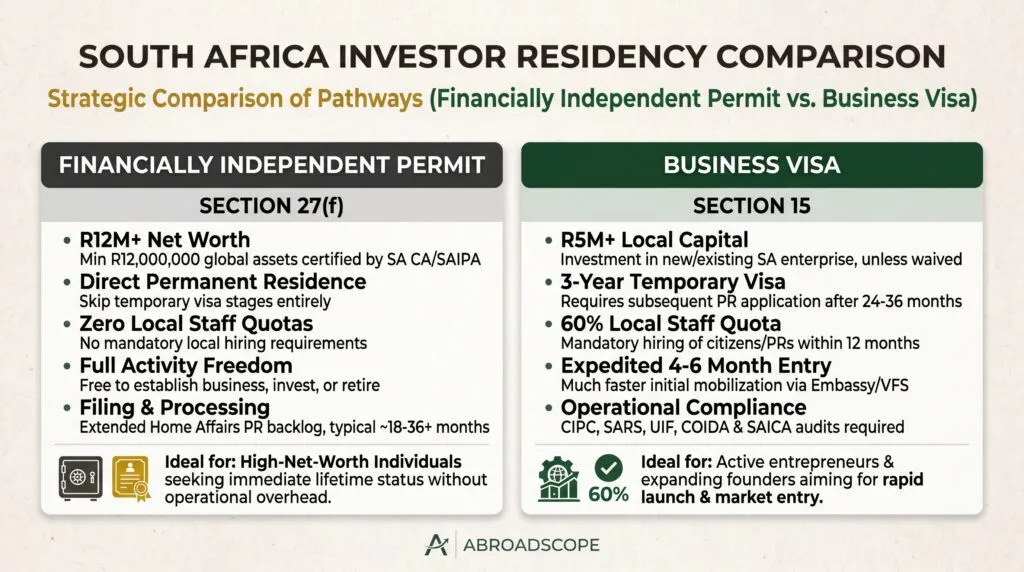
At first glance, the Business Visa looks cheaper because the headline threshold is R5 million instead of R12 million. Yet in our South Africa investor residency comparison, the real-world numbers tell a very different story. One route forces you to wire R5 million into a local company, pass government business-plan vetting, and hire a 60% South African workforce—just to receive a temporary three-year visa. The other lets you keep 100% of your wealth offshore, skips business plans and hiring quotas completely, and grants direct Permanent Residence from day one.
Understanding the legal, financial, and lifestyle trade-offs between these two permits can save you years of administrative friction and millions in locked-up capital. Here is the complete South Africa investor residency comparison for 2026.

Table of Contents
- Side-by-Side South Africa Investor Residency Comparison Table
- Capital Risk: Proving R12M Net Worth vs. Investing R5M Locally
- Residency Status: Direct Permanent Residence vs. 3-Year Renewals
- Freedom to Work, Consult, or Launch a Business
- Hidden Compliance Burdens: DTIC Vetting & The 60% Staff Quota
- Processing Timelines & Realistic Relocation Planning
- What Is Law vs. Proposed in 2026?
- The Verdict: Which Permit Fits Your Investor Profile?
Side-by-Side South Africa Investor Residency Comparison Table
Before diving into the strategic nuances, here is how South Africa’s two primary investor routes stack up across the variables that matter most to foreign founders and HNWIs:
| Comparison Factor | Financially Independent Permit (Section 27(f)) | Business Visa (Section 15) |
| Residency Status | Direct Permanent Residence (indefinite) | Temporary Residence (up to 3 years, renewable) |
| Financial Threshold | R12,000,000 global net worth | R5,000,000 foreign capital invested locally (or GN 562 waiver) |
| Capital Transfer to SA | Zero required (assets stay anywhere in the world) | Mandatory (must enter the SA business’s book value) |
| Government Approval Fee | R120,000 once-off fee (payable only after approval) | Standard DHA visa fee (R1,520) + VFS fees |
| DTIC Business Plan Vetting | None | Mandatory via DTIC VRS portal |
| 60% Local Staff Quota | None | Mandatory (Department of Labour audit within 12 months) |
| Right to Work / Trade | Unrestricted (work, consult, or start any business) | Restricted strictly to the approved South African business |
| Ongoing Reporting | None (just observe the 3-year absence rule) | 12-month staffing audit + 24-month capital proof |
| Typical Processing Time | 12–24 months (adjudicated in Pretoria) | 4–6 months (DTIC VRS + Mission/VFS) |
Capital Risk: Proving R12M Net Worth vs. Investing R5M Locally
The most important distinction in any South Africa investor residency comparison is the difference between proving wealth and deploying capital.
The Financially Independent Permit (Zero Capital at Risk)
Under Section 27(f) of the Immigration Act administered by the Department of Home Affairs, you do not invest a single Rand into South Africa. You simply prove that your personal global net worth (total assets minus liabilities) equals or exceeds R12,000,000. Your real estate in London, brokerage portfolio in New York, or private company shares in Zurich remain 100% untouched offshore.
Once your Permanent Residence is approved, you pay a once-off R120,000 fee to the Director-General. If your application were ever refused, you do not pay the R120,000. For a detailed breakdown of which assets qualify, read our guide on the R12 million net worth South Africa visa.
The Business Visa (R5M Actively Locked Into a Local Entity)
Under Section 15, you must physically commit at least R5,000,000 originating from outside South Africa into a specific South African business—either in cash or a combination of cash and new machinery/equipment. That capital is exposed to local commercial risk, South African Reserve Bank (SARB) exchange control procedures, and ongoing 24-month verification proving the funds remain invested in the enterprise.
Strategic insight: If your global net worth already clears R12 million, paying R120,000 after approval to keep R5 million liquid and unencumbered offshore is almost always the superior financial trade.
Residency Status: Direct Permanent Residence vs. 3-Year Renewals
If long-term certainty is your priority, the gap between the two permits widens further.
- Section 27(f) Grants Direct Permanent Residence: The moment your Financially Independent Permit is issued, you become a South African Permanent Resident. There are no three-year renewals, no fresh DTIC business-plan filings, and no risk of losing your status if a business venture underperforms. To keep your Permanent Residence active indefinitely, you simply must not remain outside South Africa for a continuous period of three years or more—a rule we unpack in detail in our guide to South Africa Plan B residency and tax rules.
- Section 15 Is Temporary First: A Business Visa is issued for up to three years at a time. While you can apply for Business-based Permanent Residence under Section 27(c), Pretoria’s PR queue typically forces you to complete at least one full Section 15 renewal—including a fresh DTIC recommendation and audited financial statements. Even after Section 27(c) PR is granted, it carries ongoing 2-year and 5-year investment verification checkpoints. (See our full roadmap on moving from a South Africa Business Visa to Permanent Residence.)
Freedom to Work, Consult, or Launch a Business
A widespread myth is that holding a Financially Independent Permit prohibits you from working or running a company in South Africa. That is false.
The no-work restriction applies to the temporary Retired Person Visa—not to Permanent Residence. Once your Section 27(f) Financially Independent Permit is approved, you hold the full economic rights of a South African Permanent Resident. You can:
- Launch a South African startup with R100,000 instead of R5 million.
- Buy an existing SME, guesthouse, or franchise without triggering a 60% local hiring audit.
- Take up a C-suite executive role, sit on corporate boards, or consult for local and international clients.
- Pivot industries freely—or stop working altogether.
By contrast, a Section 15 Business Visa binds you strictly to the single South African enterprise approved in your application. You cannot take on outside employment, consult for unrelated clients, or pivot into a different sector without applying for a fresh visa.
Hidden Compliance Burdens: DTIC Vetting & The 60% Staff Quota
When weighing this South Africa investor residency comparison, do not underestimate the ongoing administrative load of a Business Visa.
To secure and maintain a Section 15 Business Visa, you must clear four recurring hurdles:
- DTIC Recommendation: Submitting a comprehensive business plan and financial projections via the DTIC VRS portal to prove commercial feasibility and national interest.
- Accountant Certification: Commissioning a SAICA-, SAIPA-, or CIBA-registered Chartered Accountant certificate verifying the R5 million foreign capital.
- The 60% South African Staff Rule: Employing at least 60% South African citizens or permanent residents in permanent positions and passing a 12-month Department of Employment and Labour audit.
- Full Statutory Registrations: Maintaining active CIPC, SARS, UIF, and COIDA compliance from day one.
Under the Financially Independent Permit, every single one of those business compliance obligations disappears. Your entire compliance focus is front-loaded into compiling a clean, airtight net-worth dossier and police clearances for the initial submission.
Processing Timelines & Realistic Relocation Planning
There is one area where the Business Visa clearly beats the Financially Independent Permit: speed to boots on the ground.
- Business Visa (4 to 6 Months): Because it is a temporary residence visa adjudicated after your DTIC recommendation, a well-prepared Section 15 application typically gets you legally living and operating in South Africa within 4 to 6 months (assuming you invest the full R5 million and do not apply for a capital waiver).
- Financially Independent Permit (12 to 24 Months): Because Section 27(f) is a Permanent Residence application adjudicated by Home Affairs Head Office in Pretoria, processing routinely takes 12 to 24 months. Submitting a PR application does not grant you the right to live or work in South Africa while you wait.
The Smart Hybrid Strategy: If you qualify for the R12 million net worth threshold and need to move to South Africa immediately, you do not have to choose blindly. Many HNWIs lodge their Section 27(f) Permanent Residence application and bridge the 12-to-24-month wait using a faster temporary visa—such as the Remote Work Visitor Visa (if employed by an offshore company) or a Temporary Retirement Visa (if qualifying on R37,000/month passive income).
What Is Law vs. Proposed in 2026?
In 2026, South Africa’s Revised White Paper on Citizenship, Immigration, and Refugee Protection has proposed two major long-term shifts:
- Replacing the current Business Visa with a sector-based Investment Visa.
- Converting the passive Financially Independent Permit into an investment-based residency route.
Crucial clarity: Neither proposal is law yet. Both Section 27(f) (the R12 million net-worth route) and Section 15 (the R5 million Business Visa) remain fully active under current South African law. However, because future legislation would likely make financially independent residency stricter, HNWIs who currently qualify on net worth have a strong incentive to file under the existing Section 27(f) framework while it remains open.
The Verdict: Which Permit Fits Your Investor Profile?
Use this quick decision filter to lock in the right route:
- Choose the Financially Independent Permit (Section 27(f)) if: Your verifiable global net worth is R12 million or more, you can wait 12–24 months (or bridge with a temporary visa), and you want direct Permanent Residence with zero capital transfer, zero hiring quotas, and complete freedom to work or launch businesses later. (Review the full budget in our breakdown of the Financially Independent Permit cost in South Africa.)
- Choose the Business Visa (Section 15) if: Your net worth is below R12 million, or you are actively launching or buying an existing South African business with R5 million and need legal work authorisation on the ground within 4 to 6 months.
Structure Your South African Investor Residency with Abroadscope
Choosing between Section 27(f) and Section 15 is a multi-million-Rand decision that affects your capital liquidity, tax exposure, and long-term freedom in South Africa.
At Abroadscope, we advise high-net-worth individuals and foreign founders across both pathways. We audit your global net worth against Section 27(f) standards, structure hybrid temporary-to-PR relocation timelines, and manage full R5 million Business Visa filings through the DTIC VRS portal—ensuring you choose the cleanest, most cost-effective route from day one.
Ready to decide between the Financially Independent Permit and the Business Visa? Book a confidential Investor Residency Strategy Session with Abroadscope today.

