
For internationally mobile entrepreneurs, family offices, and high-net-worth individuals, securing a South Africa Plan B residency has quietly become one of the most practical global mobility strategies available.
Unlike European golden visas that demand hundreds of thousands of Euros locked into local real estate—or residency programmes that force you to spend 183 days a year on the ground—South Africa’s Permanent Residence framework (particularly the Financially Independent Permit under Section 27(f)) imposes zero minimum annual stay requirement and zero mandatory capital transfer. You can hold indefinite Permanent Residence in Cape Town or Johannesburg while continuing to live, work, and pay taxes in London, Zurich, Dubai, or New York.
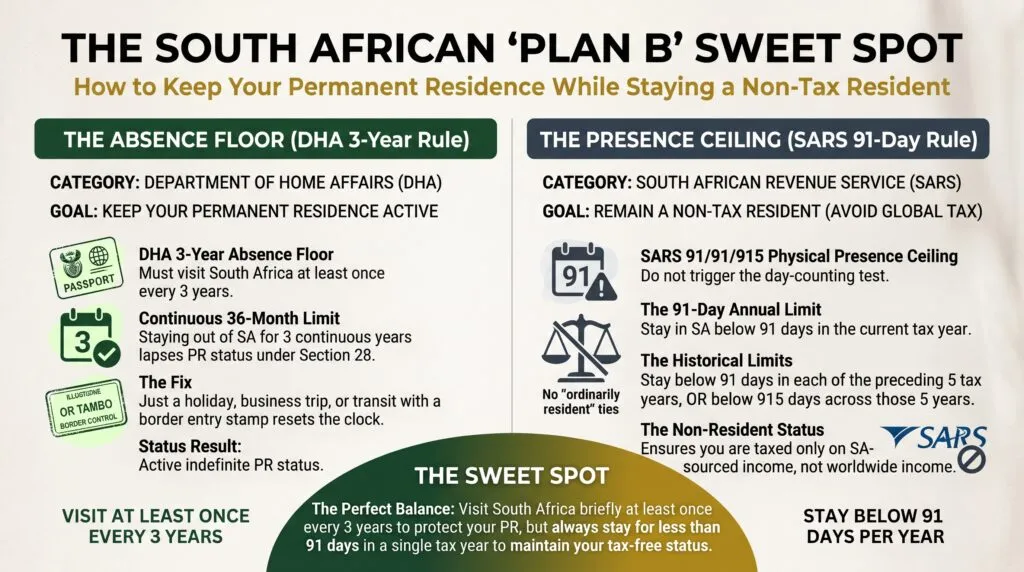
To make a South Africa Plan B residency work safely over the long term, however, you must manage two distinct legal clocks: the Department of Home Affairs (DHA) 3-year absence rule and the South African Revenue Service (SARS) tax residency tests. Here is how both rules operate in practice so you can keep your Permanent Residence active without accidentally triggering worldwide taxation.

Table of Contents
- Why South Africa Works as a “Plan B” Residency
- The 3-Year Absence Rule: How to Keep Your Permanent Residence Alive
- Statutory Exceptions to the 3-Year Absence Rule
- Does South African Permanent Residence Make You a Tax Resident?
- The Two SARS Tax Residency Tests Explained (91/91/915 Rule)
- The Sweet Spot: Staying Compliant With Both DHA and SARS
- Protect Your Global Mobility Strategy With Abroadscope
Why South Africa Works as a “Plan B” Residency
Most residency-by-investment programmes trap applicants in an uncomfortable trade-off: either you must tie up substantial capital locally, or you must relocate full-time to renew temporary permits every two years.
A South Africa Plan B residency—most commonly obtained via the R12 million net worth South Africa visa (Section 27(f))—eliminates both hurdles:
- Direct, Indefinite Permanent Residence: There are no temporary visa renewals, no expiry dates, and no ongoing business-plan or staffing audits.
- Zero Capital Transfer: Your R12 million+ global net worth remains completely offshore in your existing bank accounts, equities, or international real estate.
- Full Economic Rights on Demand: If you ever decide to activate your Plan B and relocate full-time, Permanent Residence grants you immediate, unrestricted rights to live, work, study, or launch a company in South Africa.
- No Minimum Annual Stay: You are not required to live in South Africa for a set number of months each year to keep your permit valid.
The 3-Year Absence Rule: How to Keep Your Permanent Residence Alive
While South African Permanent Residence is valid indefinitely, it is not unconditional.
Under Section 28(c) of the Immigration Act administered by the Department of Home Affairs, a Permanent Residence Permit lapses automatically if the holder is absent from South Africa for a continuous period of more than three (3) years without prior written authorisation from the Director-General.
How the 3-Year Clock Works in Practice
- Resetting the Clock: To prevent your permit from lapsing, you simply need to physically re-enter South Africa at least once every three years. Even a short holiday or business visit to Cape Town or Johannesburg—properly stamped on entry and exit—resets the three-year absence counter.
- No Automatic Reinstatement: If you accidentally cross the three-year mark abroad without prior DHA exemption, your Permanent Residence lapses automatically. There is no automatic reinstatement—you would have to submit a brand-new Permanent Residence application from scratch.
- Applying for a Prior Exemption: If exceptional circumstances prevent you from visiting South Africa within three years, you may apply in writing to the Director-General before the three-year period expires, showing good cause to extend the permitted absence.
(Compliance Note: Keep digital and physical copies of every South African entry/exit passport stamp and boarding pass. If you ever apply for a South African Permanent Resident ID or confirm your status at a Mission, clean travel records are essential.)
Statutory Exceptions to the 3-Year Absence Rule
The Immigration Act carves out narrow statutory exceptions where an absence of more than three years does not automatically trigger the withdrawal of your Permanent Residence:
- Working for a South African Entity Abroad: You were residing abroad as a representative or employee of a person or association of persons resident or established in South Africa.
- International Organisation Service: You were residing abroad in the service of an international organisation of which South Africa is a member.
- Accompanying Spouses & Dependent Children: You are the spouse or dependent child residing abroad with a person covered under (1) or (2), or residing abroad with a South African citizen spouse or parent.
If you do not fall squarely into one of these exceptions, treat a short visit to South Africa every 18 to 30 months as a non-negotiable calendar reminder.
Does South African Permanent Residence Make You a Tax Resident?
No. This is the single most important legal distinction for any South Africa Plan B residency holder: immigration residency and tax residency are completely separate.
Holding a South African Permanent Residence Permit does not automatically make you a tax resident with the South African Revenue Service (SARS). South Africa operates a residence-based tax system:
- South African Tax Residents are taxed by SARS on their worldwide income (subject to applicable Double Taxation Agreements and exemptions).
- Non-Residents for Tax Purposes are taxed by SARS only on income derived from a South African source (such as rental income from a Cape Town apartment or a salary earned for work physically performed inside South Africa).
As long as you remain a non-resident for tax purposes, your offshore dividends, foreign salaries, and international capital gains stay outside the SARS tax net.
The Two SARS Tax Residency Tests Explained (91/91/915 Rule)
To determine whether a foreign Permanent Resident has crossed into South African tax residency, SARS applies two independent legal tests:
1. The “Ordinarily Resident” Test (Intent & Real Home)
SARS first asks a qualitative question: is South Africa your real, permanent home—the country to which you naturally and as a matter of course return from your wanderings?
If your primary residence, family life, main business operations, and habitual centre of living remain in the UK, Europe, the Middle East, or North America—and you only visit South Africa seasonally—you are generally not ordinarily resident in South Africa.
2. The “Physical Presence” Test (The 91 / 91 / 915 Rule)
Even if you are not ordinarily resident in South Africa, you will automatically become a South African tax resident if you exceed all three day-count thresholds in the Physical Presence Test:
- Physically present in South Africa for more than 91 days in aggregate during the current South African tax year (1 March to 28/29 February); AND
- Physically present in South Africa for more than 91 days in aggregate during each of the five preceding tax years; AND
- Physically present in South Africa for more than 915 days in aggregate across those five preceding tax years.
| Legal Clock | Governing Authority | Threshold to Watch | Consequence if Breached |
| Immigration Presence | Department of Home Affairs (DHA) | Absent for more than 3 consecutive years | Permanent Residence lapses automatically |
| Tax Residency (Intent) | SARS (Ordinarily Resident Test) | Making South Africa your primary permanent home | Taxed on worldwide income |
| Tax Residency (Days) | SARS (Physical Presence Test) | >91 days this year + >91 days in each of past 5 years + >915 days total | Taxed on worldwide income (subject to DTA tie-breakers) |
The Sweet Spot: Staying Compliant With Both DHA and SARS
When you map both legal clocks together, the practical South Africa Plan B residency strategy becomes remarkably clear:
- Stay Above the DHA Floor: Visit South Africa at least once every 24 to 30 months (safely inside the 3-year window) so your Permanent Residence never lapses.
- Stay Below the SARS Ceiling: If you want to enjoy South Africa’s summer season every year without triggering the Physical Presence Test, keep your visits to 90 days or fewer per South African tax year (1 March to 28/29 February) and maintain your primary home and tax residency abroad.
- Know Your Double Taxation Agreement (DTA): South Africa maintains an extensive network of Double Taxation Agreements (including with the UK, US, Germany, Switzerland, and the Netherlands). Even if an extended stay ever triggers dual tax residency, DTA tie-breaker rules determine which country has primary taxing rights.
(Budgeting tip: If you are comparing the Financially Independent Permit against launching a local company for your Plan B, read our South Africa investor residency comparison and our full breakdown of the Financially Independent Permit cost in South Africa.)
Protect Your Global Mobility Strategy With Abroadscope
A South Africa Plan B residency offers something increasingly rare in global immigration: indefinite Permanent Residence with zero capital lock-up, zero annual stay minimums, and complete freedom to activate your move whenever the world—or your family—calls for it.
At Abroadscope, we structure Section 27(f) Financially Independent Permits for global investors, family offices, and internationally mobile founders. We pre-audit your global net worth with SAICA-registered Chartered Accountants, manage your Permanent Residence filing through to approval, and coordinate alongside cross-border tax specialists so your immigration and tax strategies stay seamlessly aligned.
Ready to lock in South African Permanent Residence as your global Plan B? Book a confidential HNWI Residency Strategy Session with Abroadscope today.

