
For multinational corporations deploying existing executives, regional directors, or senior technical specialists to a South African subsidiary, the Intra-Company Transfer (ICT) Work Visa under Section 19(5) of the Immigration Act is the undisputed workhorse of corporate mobility.
Its primary appeal is speed and predictability: unlike a General Work Visa, an ICT application is completely exempt from South Africa’s 100-point work visa matrix and requires no proof of local labour-market recruitment efforts. If your group has an established South African branch, subsidiary, or affiliate and an employee who has been on your overseas payroll for at least six months, you can relocate them cleanly for up to four years.
However, the ICT visa comes with two unforgiving statutory strings that catch HR teams off guard every year: a mandatory Measurable Skills Transfer Plan naming specific South African trainees, and a strict, non-renewable 4-year expiry ceiling with zero direct pathway to Permanent Residence. Here is how to structure a compliant ICT filing and plan your executive’s exit or transition before the clock runs out.

Who Qualifies for a South African Intra-Company Transfer (ICT) Visa?
The Section 19(5) ICT visa is strictly for existing group employees—it cannot be used to hire new external talent or to launch a brand-new startup entity that does not yet exist in South Africa.
To qualify, your application must satisfy three non-negotiable eligibility pillars:
- Six Months of Prior Foreign Employment: The assignee must have been formally employed by the foreign sending company abroad for at least six months immediately prior to the transfer. Directors without a formal employment contract, freelance contractors, and newly hired staff do not qualify.
- A Verifiable Corporate Group Link: The South African host entity must be an existing branch, subsidiary, or affiliate of the overseas employer. Home Affairs requires hard documentary proof of this corporate relationship—such as CIPC registration documents, share certificates, or a certified corporate group shareholding chart.
- A Defined Assignment Within Four Years: The transfer must be structured around a specific role and capacity at the South African entity that fits within the maximum 4-year window.
Where must you apply? An initial ICT visa must be lodged in person at the South African Diplomatic Mission or VFS Global centre in the employee’s country of residence abroad. Applications submitted from inside South Africa on a visitor visa will not be accepted.
What Must Be Included in a Compliant Skills Transfer Plan?
Home Affairs grants ICT visas on the express policy condition that the foreign assignee will upskill local talent during their secondment. A generic one-page statement promising to “mentor local staff” is a fast track to refusal.
Under the Immigration Regulations, the South African host entity must submit a formal, time-bound Measurable Skills Transfer Plan demonstrating exactly how specialised technical or managerial expertise will be transferred to South African citizens or permanent residents.
Required Components of the Skills Transfer Plan
- Assignee & Host Profile: Full details of the foreign employee (passport number, current foreign role, proposed South African duties, and justification for why their expertise is needed) alongside the South African entity’s CIPC and SARS good-standing details and local vs. foreign headcount.
- Organisational Chart & Reporting Lines: Where the assignee sits inside the South African entity, who they report to, and how they integrate with local staff.
- Specific Skills & Training Methodology: Clear breakdown of technical skills (e.g., engineering, IT systems, operations) and managerial skills to be transferred, paired with structured delivery methods (shadowing, workshops, one-on-one mentoring) and measurable milestones across the assignment.
- Named South African Trainee Dossier: Crucially, Missions and Home Affairs require supporting documentation for the specific South African citizen or permanent resident trainee(s) named in the plan—including a copy of their South African ID document, their current position in the company, level of qualifications, and Trainee’s CV alongside the Applicant’s CV.
Compliance warning: The Department of Home Affairs reserves the right to conduct audits or request proof of skills-transfer progress during the visa period. Treat the plan as a live HR deliverable, not a box-ticking exercise.
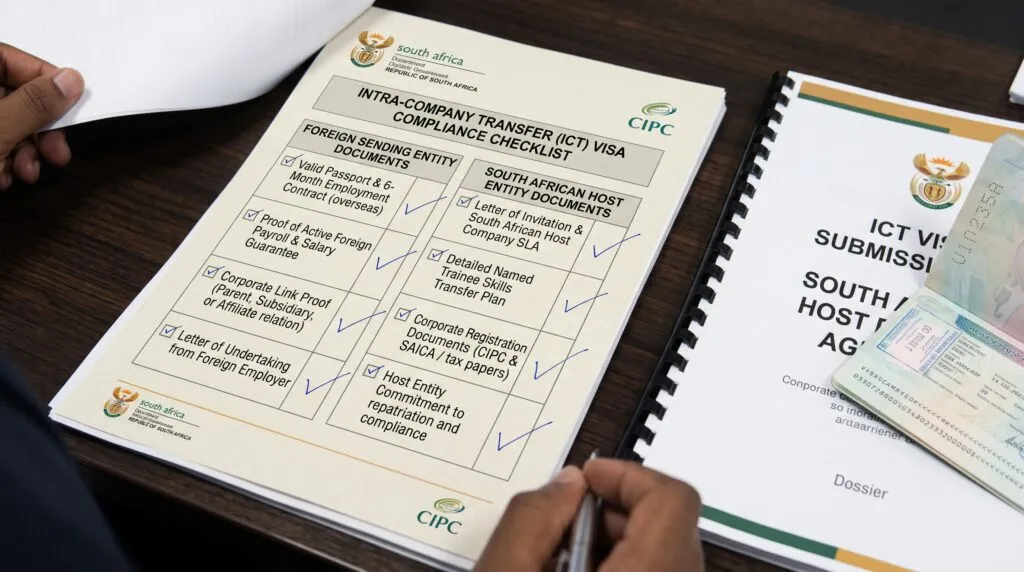
Complete ICT Visa Document Checklist
Because discrepancies between the foreign sending letter, the South African host letter, and Form DHA-1738 are grounds for refusal, both entities must coordinate their documentation carefully:
| Document Category | Mandatory Requirements |
| Application & Identity | Duly completed Form DHA-1738 signed in black ink only; valid machine-readable passport (valid at least 30 days beyond intended stay with 3 blank pages); two compliant passport photographs. |
| Employment & Corporate Link | Foreign employment contract proving 6+ months of prior employment; proof of corporate relationship (CIPC docs, share certificates, or group chart). |
| Transfer Letters | Letter from the foreign employer confirming the transfer to the SA branch/subsidiary/affiliate; letter from the SA host entity confirming the transfer, exact occupation, and capacity. |
| Mandatory Employer Undertakings | Signed undertakings by the employer to ensure the employee departs South Africa at the end of 4 years, maintains a valid passport at all times, works only in the authorised position, and covering deportation costs if required. |
| Skills Transfer Pack | Measurable Skills Transfer Plan plus named South African trainee(s)’ ID copy, CV, qualifications, and current role. |
| Health & Character | Police clearance certificates from every country lived in for 12+ months (in the last 5 years since turning 18); medical report (less than 6 months old); Yellow Fever certificate if applicable. |
| Accompanying Family | Certified marriage certificate (or life partner affidavit) and unabridged birth certificates for minor children. (Note: Accompanying spouses do not receive automatic work rights.) |
The Strict 4-Year Limit: Can You Renew or Extend an ICT Visa?
No. Under Regulation 18(10) of the Immigration Regulations, an Intra-Company Transfer Work Visa is issued for a period not exceeding four years and is not renewable.
There is no extension mechanism and no grace period. When the four-year stamp expires, the executive must depart South Africa on or before the expiry date unless a different valid visa is already in place. Overstaying triggers an automatic declaration of undesirability under Section 30(1)(h), carrying re-entry bans of 12 months to 5 years.
Equally important for long-term workforce planning: the ICT visa does not lead to Permanent Residence. Time spent in South Africa on an ICT visa does not count toward the five-year continuous work visa requirement for General Work Permanent Residence.
How to Transition Before Your 4-Year ICT Visa Expires
The single most costly mistake multinational HR teams make is waiting until Year 4 to realise they want to keep a transferred executive in South Africa permanently. Because an ICT holder generally cannot convert to another work visa category from inside South Africa, transition planning must begin at least 12 months before the ICT expiry date.
Depending on the executive’s profile, three primary onward pathways exist:
- Points-Based General or Critical Skills Work Visa (From Abroad): If the executive’s role aligns with South Africa’s Critical Skills List—or scores 100 points on the gazetted work visa matrix (leveraging salary thresholds of R650,976 / R976,194, NQF qualifications, experience, and 30 points if your entity is a Trusted Employer)—they can transition onto a 5-year renewable work visa that does build toward Permanent Residence.
- Financially Independent Permit (Section 27(f)): For senior C-suite executives with a global net worth of R12 million or more, applying directly for Permanent Residence via the Financially Independent Permit bypasses work-visa renewals entirely and grants full freedom to work for any South African employer.
- Planned Repatriation or Regional Rotation: Rotating the executive back to headquarters or another regional hub before day 1,460, while handing operational control to the upskilled South African successor trained under the Skills Transfer Plan.
Move Your Multinational Talent Into South Africa Seamlessly
An Intra-Company Transfer visa is the fastest way to place trusted group leadership on the ground in South Africa—provided your corporate shareholding proof is airtight, your Measurable Skills Transfer Plan names real local trainees, and your HR team maps the 4-year exit strategy before day one.
At Abroadscope, we manage end-to-end ICT secondments for multinational corporations and regional headquarters. We audit your corporate group link, draft compliant Measurable Skills Transfer Plans, prepare both sending and host entity letters, and build a 4-year onward residency roadmap so your leadership team never faces a compliance cliff.
Relocating an executive or specialist to your South African subsidiary? Book a confidential corporate mobility consultation with Abroadscope today.

