
For years, hiring a foreign executive or specialist on a South African General Work Visa was one of the most frustrating compliance exercises in corporate mobility. Employers had to run local newspaper recruitment drives, interview local applicants, and wait months—sometimes over a year—for a Department of Employment and Labour (DEL) waiver recommendation that was frequently refused.
That bottleneck is gone. Following the landmark gazetting of Government Notice 5448 (Government Gazette 51416) in October 2024, South Africa replaced the old Department of Labour recruitment hurdle with an objective 100-Point Work Visa System (Points-Based System / PBS).
In 2026, the points matrix is firmly established as the primary gateway for hiring skilled foreign talent locally. Yet despite being in force for two years, widespread misinformation still circulates online—including an outdated salary figure copied from a withdrawn draft notice that causes HR teams to miscalculate executive eligibility. Here is the exact gazetted 100-point matrix, worked executive scenarios, and the 2026 regulatory updates every employer and applicant needs to know.

Which South African Visas Use the 100-Point System?
Before calculating your score, confirm that your visa category actually falls under the Points-Based System. The 100-point matrix applies exclusively to two long-term work visas:
- General Work Visa (Section 19(2))
- Critical Skills Work Visa (Section 19(4))
It does not apply to Intra-Company Transfer (ICT) Visas, Section 11(2) Short-Term Work Visas, Corporate Visas, Business Visas, or the Remote Work Visitor Visa.
How the 100-point pass mark determines your visa class:
- If you reach 100 points through an occupation on the Critical Skills List, you qualify for a Critical Skills Work Visa.
- If your role is not on the Critical Skills List—and you reach 100 points through any combination of salary, qualifications, experience, language, and Trusted Employer status—you qualify for a General Work Visa.
Both visas are generally issued for the duration of the employment contract up to five years and provide a direct pathway toward Permanent Residence.
The Official 2026 South Africa 100-Point Work Visa Matrix
To qualify, an applicant must score at least 100 points across the gazetted criteria below. Importantly, there are zero points for age, and the salary bands have remained unchanged since gazetting.
| Scoring Criterion | Qualifying Tier | Points Awarded |
| Critical Skills List Occupation | Occupation appears on the current Critical Skills List (3 October 2023 list) | 100 points |
| Qualifications (SAQA Evaluated) | NQF Level 9 or 10 (Master’s Degree or Doctorate/PhD) | 50 points |
| NQF Level 7 or 8 (Bachelor’s Degree, Honours, or Postgraduate Diploma) | 30 points | |
| Annual Gross Salary (Offer Mandatory) | Above R976,194 gross per annum | 50 points |
| Between R650,976 and R976,194 gross per annum | 20 points | |
| Relevant Work Experience | More than 10 years of relevant experience | 30 points |
| 5 to 10 years of relevant experience | 20 points | |
| Trusted Employer Status | Job offer from an approved Trusted Employer Scheme (TES) company | 30 points |
| Official Language Proficiency | Proficiency in at least one of South Africa’s official languages (e.g., English) | 10 points |
Correcting the R650,796 Salary Typo Online
If you have researched South Africa’s points system elsewhere, you have almost certainly seen the lower salary band quoted as R650,796. That figure is wrong. It originated from an earlier draft notice that was formally withdrawn.
The legally binding gazetted lower threshold is R650,976 gross per annum. While the difference is only R180 per year, structuring an employment contract at R650,800 based on an outdated blog post will drop your salary score from 20 points to zero and trigger an avoidable refusal. Always benchmark contracts strictly against R650,976 (20 points) and R976,194 (50 points) in gross annual remuneration.
Is a Job Offer Mandatory?
Yes. The gazetted table marks an Offer of Employment as mandatory. You cannot self-sponsor a General Work Visa on points alone without a formal South African employment contract—and in practice, a salary falling below the R650,976 lower band makes General Work Visa approval highly unlikely.
Worked Examples: How Executives & Founders Score in Practice
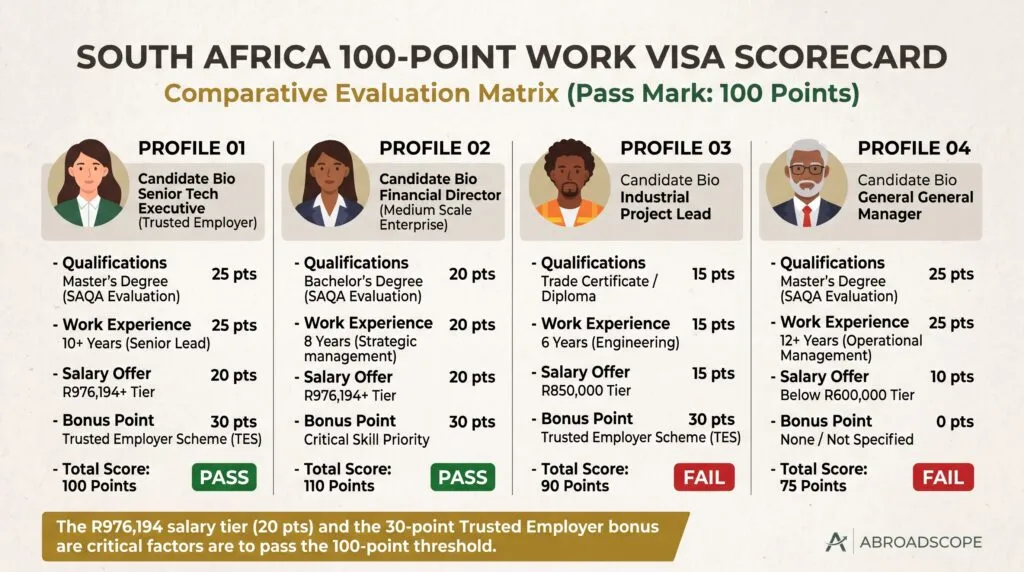
Because the 100-point matrix is strictly mathematical, small differences in degree level, salary banding, or employer accreditation dramatically alter the outcome. Here are four realistic 2026 corporate hiring scenarios:
Scenario 1: Senior European Operations Director (Qualifies Easily)
- Profile: Hired by a non-TES Cape Town manufacturing firm; holds a Bachelor’s degree (NQF 7), 12 years of experience, fluent in English, offered R1,200,000 gross per annum.
- Score Breakdown: NQF 7 (30) + Salary > R976,194 (50) + 10+ Years Experience (30) + English Proficiency (10) = 120 Points.
- Verdict: Qualifies for a General Work Visa (even without Trusted Employer status).
Scenario 2: Mid-Career Specialist at a Standard Company (Falls Short by 10 Points)
- Profile: Hired by a non-TES Johannesburg tech firm in a role not on the Critical Skills List; holds a Bachelor’s degree (NQF 7), 11 years of experience, fluent in English, offered R800,000 gross per annum.
- Score Breakdown: NQF 7 (30) + Salary R650,976–R976,194 (20) + 10+ Years Experience (30) + English Proficiency (10) = 90 Points.
- Verdict: Does not qualify. To bridge the 10-point gap, the employer must either raise the gross package above R976,194 (+30 points), hold Trusted Employer accreditation (+30 points), or assess whether the candidate has an NQF 9 Master’s degree (+20 points).
Scenario 3: The Same Candidate Hired by a Trusted Employer (Qualifies)
- Profile: Identical candidate to Scenario 2 (Bachelor’s degree, 11 years’ experience, R800,000 gross salary, English), but the hiring company is accredited under DHA’s Trusted Employer Scheme (TES).
- Score Breakdown: NQF 7 (30) + Salary Band (20) + 10+ Years Experience (30) + Trusted Employer (30) + English (10) = 120 Points.
- Verdict: Qualifies. This illustrates why TES accreditation—which expanded via Phase II in mid-2026 for strategic infrastructure and regional/global headquarters—is a massive competitive hiring advantage.
Scenario 4: Young Master’s Graduate in a High-Paying Niche Role (Qualifies)
- Profile: 3 years of work experience (0 experience points), holds a Master’s degree (NQF 9), hired by a boutique financial advisory firm at R1,050,000 gross per annum, fluent in English.
- Score Breakdown: NQF 9 (50) + Salary > R976,194 (50) + English (10) = 110 Points.
- Verdict: Qualifies—even with fewer than five years of work experience.
Key 2026 Regulatory Updates You Must Factor In
Scoring 100 points proves eligibility, not automatic approval—you still have to clear every documentary and verification hurdle. Four major regulatory realities govern applications in late 2026:
1. The Pending SAQA Evaluation Rule (12-Month Bridge Visa)
Historically, waiting for the South African Qualifications Authority (SAQA) to evaluate a foreign degree added months of dead time before a visa could even be filed. Under the updated rules, you can now lodge your General or Critical Skills Work Visa using proof of a pending SAQA application. Home Affairs will issue an initial 12-month work visa so the executive can start working immediately, and extend it to the full five-year term once the positive SAQA Certificate of Evaluation is issued within that year.
Compliance trap: Always pre-audit your foreign qualification before relying on the pending SAQA rule. If you claim 30 points for an NQF 7 Bachelor’s degree, only for SAQA to evaluate your specific overseas diploma as NQF 6 (0 points), your extension will fail.
2. Routine Medical Report Requirement Waived (July 2026)
Per Ministerial Directive issued on 8 July 2026, the routine medical-report submission requirement was waived for covered work visa applications—further streamlining document preparation alongside the earlier removal of radiological reports. Police clearance certificates (covering every country where you resided for 12+ months in the preceding 5 years since turning 18, and less than 6 months old at lodgement) remain strictly mandatory.
3. Critical Skills List & Professional Body Registration
If you are claiming 100 points via the Critical Skills Work Visa, note that the Critical Skills List of 3 October 2023 remains the active list in 2026—no new list has been gazetted yet. In addition to SAQA verification, Critical Skills applicants must still secure formal confirmation/registration from the relevant South African statutory professional body (such as ECSA, SAICA, or SACNASP).
4. White Paper Proposals vs. Current Law
In April 2026, Cabinet approved a Revised White Paper proposing to merge the General Work Visa and Critical Skills Work Visa into a single “Skilled Worker Visa,” alongside the proposed Employment Services Amendment Bill. Neither proposal is law yet. All 2026 applications are adjudicated strictly under the current 100-point matrix and Immigration Act framework.
Processing Times & In-Country Rules
Home Affairs’ current service target for General Work and Critical Skills Visas lodged in South Africa is four weeks, though foreign Mission timelines vary depending on your country of residence.
Critical warning on starting work early: Under Directive 7 of 2026, pending applicants inside South Africa have their legal stay and travel protected through 30 June 2027, strictly under the conditions of their existing visa. A foreign executive who enters South Africa on a standard visitor visa cannot begin working while waiting for a work visa outcome—doing so breaches Section 38 and exposes both the executive and the employer to severe penalties.
Audit Your 100-Point Score Before Signing the Contract
South Africa’s 100-point work visa system has transformed executive hiring from a bureaucratic guessing game into a predictable strategic calculation. Still, a single misread salary threshold, an unexpected SAQA NQF downgrade, or an expired police clearance can stall a senior hire for months.
At Abroadscope, we audit every candidate’s 100-point scorecard before your employment contract is finalised. We verify foreign degrees against SAQA NQF benchmarks, structure compliant gross salary packages against the exact gazetted thresholds, manage pending SAQA filings, and guide both General and Critical Skills Work Visas through to rapid approval.
Hiring a foreign executive—or calculating your own 100-point score for South Africa? Book a confidential Work Visa Points Audit with Abroadscope today.

