
Every year, hundreds of European, UK, and North American founders fall in love with Cape Town’s tech ecosystem, GMT+2 time zone, and lifestyle—and immediately face a pivotal immigration fork in the road.
On one side sits South Africa’s Remote Work Visitor Visa (often called the Digital Nomad Visa), introduced under Section 11(1)(b)(iv) of the Immigration Act. It requires zero local capital investment, no business plan, and no South African hiring quotas. On the other side sits the Section 15 Business Visa—a heavier compliance route requiring R5 million in foreign capital, a DTIC recommendation, and a 60% South African workforce, but unlocking full local commercial rights and a direct pathway to Permanent Residence.
Choosing the wrong visa at the outset is an expensive mistake. Because South African immigration law strictly prohibits changing from a Remote Work Visitor Visa to another visa class inside the country, a founder who picks the wrong permit often has to fly home and start from scratch. Here is the definitive side-by-side comparison to help international founders choose the right structure in 2026.

Side-by-Side Comparison: Remote Work Visa vs. Business Visa
Before diving into the founder-specific legal nuances, here is how the two permits stack up across the factors that matter most to international entrepreneurs:
| Feature | Remote Work Visitor Visa (Sec 11(1)(b)(iv)) | Business Visa (Section 15) |
| Financial Threshold | Minimum gross annual salary of R650,976 (~$37k–$39k USD) | Minimum R5,000,000 foreign capital (or GN 562 waiver) |
| Local South African Trading | Strictly prohibited (no SA clients or SA employment) | Fully permitted within the approved SA enterprise |
| 60% Local Staff Quota | None | Mandatory (60% permanent SA citizens/PRs within 12 months) |
| DTIC & Accountant Vetting | None (3 months bank statements + contract) | Mandatory (DTIC VRS recommendation + SAICA/SAIPA report) |
| Maximum Duration | Over 3 months, up to 3 years | Up to 3 years (renewable) |
| In-Country Status Change | Not permitted (must apply from abroad) | Renewals and PR filings permitted in South Africa |
| Path to Permanent Residence | No | Yes (direct eligibility under Section 27(c)) |
| Typical Processing Time | 4–8 weeks (at Mission abroad) | 4–6 months (DTIC VRS + Mission/VFS) |
Can a Foreign Company Founder Qualify for South Africa’s Remote Work Visa?
This is the first major hurdle that catches entrepreneurs off guard.
South Africa’s Remote Work Visitor Visa was drafted primarily for salaried remote employees—not informal freelancers. The official Department of Home Affairs checklist requires a valid contract of employment signed by both the applicant and a foreign-based employer, backed by three months of bank statements proving a gross annual salary meeting the R650,976 threshold.
What does this mean if you own your own business abroad?
- Solo Freelancers / Unincorporated Sole Proprietors: If you invoice a rotating mix of ad-hoc clients without an underlying employment contract, your Remote Work Visa application faces a high risk of rejection.
- Incorporated Foreign Founders (UK Ltd, US C-Corp/LLC, EU GmbH): If you are the founder or majority shareholder of an incorporated foreign company, you can often qualify cleanly—provided you are formally employed by that foreign corporate entity under a signed executive employment contract paying a regular, verifiable monthly salary that clears the R650,976 annual threshold (rather than irregular shareholder dividends).
The Commercial Boundary: Offshore Operations vs. Local Expansion
Your commercial roadmap for the next 24 to 36 months should dictate your visa choice—not the upfront paperwork.
Choose the Remote Work Visitor Visa If:
- Your customers, revenue, and payroll sit 100% outside South Africa.
- You are running a SaaS platform, e-commerce brand, or international consultancy from Cape Town or Johannesburg with zero intention of invoicing South African clients, signing local commercial leases, or hiring local South African staff.
- You want to test-drive living in South Africa for 6 to 36 months without locking R5 million into a local entity.
Choose the Section 15 Business Visa If:
- You want to open a South African subsidiary (
Pty Ltd), acquire an existing South African SME, or build a local engineering, BPO, or hospitality team. - You plan to sell to South African clients, sign local commercial contracts, or manage local operations hands-on.
- You want to build toward South African Permanent Residence under Section 27(c).
Compliance warning: Do not enter South Africa on a Remote Work Visitor Visa and quietly begin pitching local South African clients or hiring South African developers under the table. Taking up local employment or conducting unauthorised local commercial activity breaches your visitor visa conditions and violates Section 38 of the Immigration Act.
Tax & Corporate Structuring: The Hidden Trap for Remote Founders
Many founders assume that holding a Remote Work Visitor Visa automatically shields them from the South African Revenue Service (SARS). It does not.
Under the Remote Work Visitor Visa rules, tax compliance depends on how long you stay and whether your home country has a Double Taxation Agreement (DTA) with South Africa:
- Stays of 183 Days or Fewer (DTA Countries): If you are a tax resident in a country with a valid South African DTA (such as the UK, US, Germany, or the Netherlands) and spend 183 days or fewer in South Africa in any 12-month period, you are generally exempt from registering with SARS.
- Stays Exceeding 183 Days—or Non-DTA Countries: If your stay exceeds 183 days in a 12-month period—or if you are not tax resident in a DTA treaty country—you are legally required to register with SARS.
The Founder-Specific Risk: Place of Effective Management (POEM)
If you are a founder and sole director running your foreign company full-time from a desk in Cape Town for two or three years on a Remote Work Visa, your personal tax is only half the equation. Under South African corporate tax law, if the key executive and strategic decisions of a foreign company are regularly made from inside South Africa, SARS may deem that offshore company to have its Place of Effective Management (POEM) or a Permanent Establishment (PE) in South Africa—potentially pulling the foreign company itself into the South African corporate tax net.
Before staying beyond 183 days as a foreign company director, always coordinate your immigration strategy with a cross-border South African tax specialist.
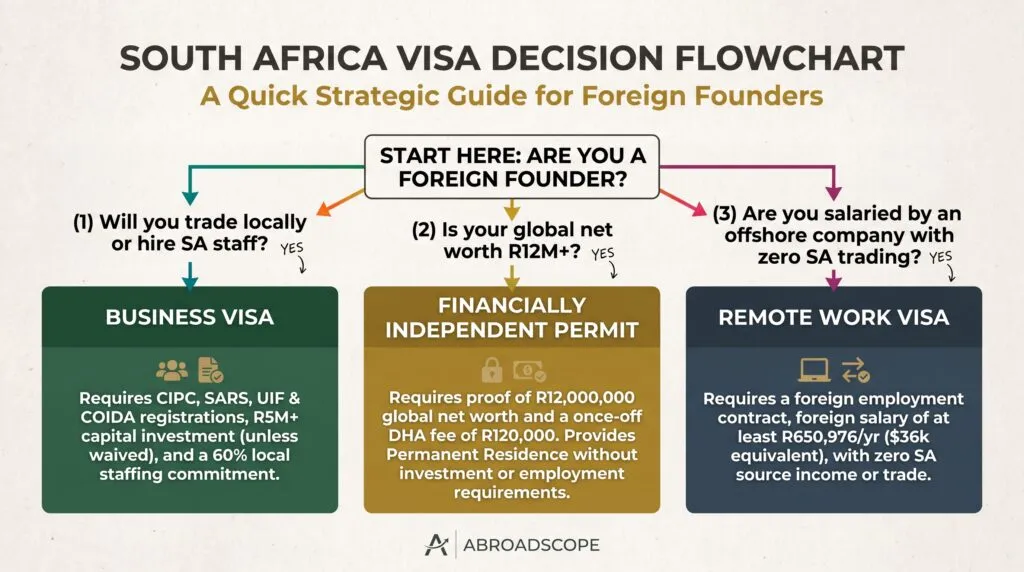
The Third Option Many Founders Overlook: The Financially Independent Permit
If you are an established founder who has already had a liquidity event or built a global net worth of R12 million or more (across global real estate, equities, cash, and business equity), there is a third pathway that beats both the Remote Work Visa and the Business Visa: the Financially Independent Permit (Section 27(f)).
Unlike the Business Visa, it requires zero transfer of capital into South Africa, zero DTIC business plans, and zero 60% local hiring quotas. Unlike the Remote Work Visa, it grants direct Permanent Residence—giving you total freedom to run your offshore company, launch a South African startup, or buy local businesses whenever you choose, for a once-off R120,000 DHA fee payable only after approval.
Make the Right Call Before You Apply
Choosing between South Africa’s Remote Work Visitor Visa and Section 15 Business Visa comes down to one honest question: are you relocating your lifestyle while keeping your business offshore, or are you building a commercial footprint inside South Africa?
At Abroadscope, we advise international founders on both sides of this equation. We audit your foreign employment contract and income proof for Remote Work Visa compliance, structure R5 million Business Visa filings through the DTIC VRS portal, and evaluate whether direct Permanent Residence via the Financially Independent Permit is a smarter long-term fit—so you never get trapped in the wrong visa category.
Planning your move to South Africa as a foreign founder? Book a confidential Founder Relocation Strategy Session with Abroadscope today to choose the cleanest, most compliant pathway.

