
For large enterprises, infrastructure developers, and multinational headquarters operating in South Africa, recruiting senior global talent has historically been slowed down by paperwork-heavy work visa filings and unpredictable adjudication queues.
To fix that bottleneck for high-impact investors, the Department of Home Affairs (DHA) introduced the Trusted Employer Scheme (TES)—a dedicated fast-track accreditation programme designed to reward compliant, large-scale employers with simplified documentation, priority adjudication, and a major scoring boost under South Africa’s 100-point work visa system.
On 20 July 2026, Home Affairs significantly expanded the programme by gazetting TES Phase II (Government Gazette No. 55036, Notice No. 7715) alongside a fully digitalised Digital TES Platform. Following the Phase II Expression of Interest window (which closed on 4 September 2026, with outcomes announced on 5 November 2026), accredited employers are now leveraging faster, digitalised executive mobilisation. Whether your company is preparing for the next TES intake window or evaluating whether to recruit through an accredited entity, here is how Phase II works and what it actually delivers.

What Is the Trusted Employer Scheme (TES) in South Africa?
The Trusted Employer Scheme is an official Department of Home Affairs corporate accreditation programme that grants vetted, large-scale employers a streamlined channel for hiring skilled foreign nationals—specifically senior executives, technical specialists, corporate transferees, and investors.
Home Affairs is explicit on one core boundary: TES is strictly for high-skilled, senior, and technical roles—it cannot be used for unskilled or low-wage labour.
Unlike standard visa filings that require employers to re-prove their corporate bona fides from scratch with every new hire, TES front-loads the vetting process. An interdepartmental committee—comprising Home Affairs, the Department of Employment and Labour (DEL), and the Department of Trade, Industry and Competition (the dtic)—evaluates the company once. If approved, the employer signs a formal Memorandum of Agreement (MOA) with DHA and unlocks priority visa processing both locally and across all South African High Commissions and Embassies abroad.
What Are the Key Benefits of Trusted Employer Status in 2026?
Accreditation under TES delivers four concrete operational advantages for multinational HR and global mobility teams:
- 30 Automatic Points on the 100-Point Work Visa Matrix: Under South Africa’s Points-Based System (PBS) for General Work Visas, a job offer from a Trusted Employer automatically awards the foreign candidate 30 points. For mid-career specialists or managers who hold a Bachelor’s degree (30 points) and sit in the R650,976–R976,194 salary tier (20 points), those 30 TES points are often the exact difference between an outright refusal and a clean approval.
- Reduced Upfront Documentation: Accredited employers benefit from pared-back supporting document requirements when filing Critical Skills Work Visas, General Work Visas, and Intra-Company Transfer (ICT) Visas—including concessions on duplicate skills-transfer paperwork where the company already operates a recognised Graduate Development Programme. (Note: Reduced upfront filing does not eliminate underlying statutory obligations—employers must still retain full supporting records for DHA compliance audits.)
- Priority Turnarounds & Digital TES Platform: Phase II introduced a fully digital, end-to-end TES management platform that reduces manual bottlenecks. Approved employers receive priority handling at Visa Facilitation Centres and Missions abroad, aligning with DHA’s streamlined work-visa turnaround targets (roughly 4 weeks) and expedited Permanent Residence processing for fully compliant files.
- Global Mission Recognition: TES membership is honoured not only for in-country renewals and applications, but at South African Diplomatic Missions worldwide—giving international hires far greater predictability before relocating.
Important reality check: Trusted Employer status simplifies and accelerates adjudication, but it does not guarantee automatic approval for every individual hire. Every foreign executive must still meet the statutory eligibility, police clearance, and legislative requirements for their specific visa category.
TES Phase II: The Three 100-Point Qualification Pathways
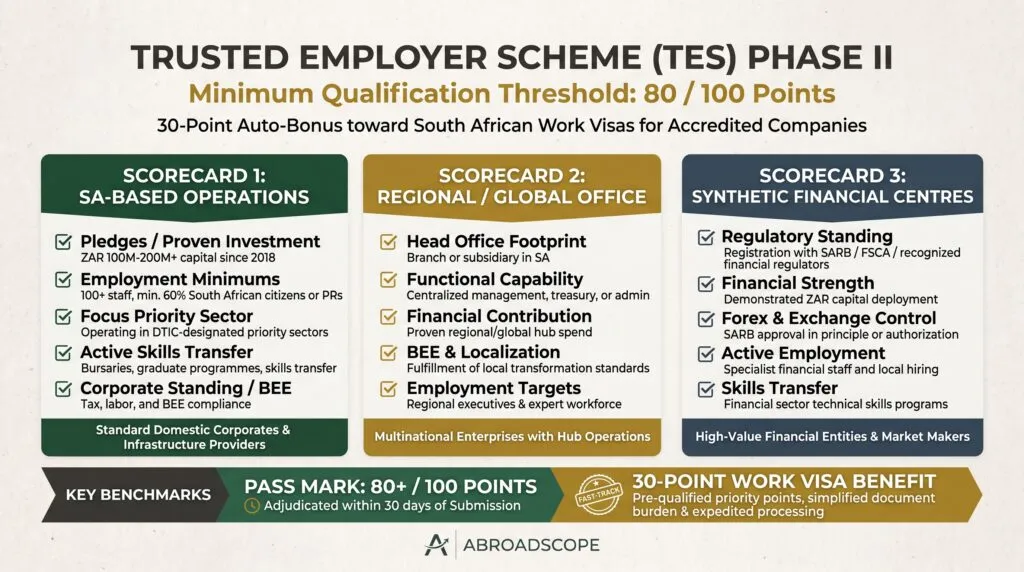
The biggest structural change introduced by Phase II in July 2026 was expanding eligibility beyond the original pilot framework. Instead of a single one-size-fits-all test, Phase II introduced three distinct qualification pathways, each scored out of 100 points.
To qualify, a company must achieve at least 80 out of 100 points on its chosen scorecard. Critical rule: You may only apply under one pathway—submitting under multiple scorecards triggers automatic disqualification.
Pathway 1: South African-Based Operations (Updated Pilot Scorecard)
Designed for established corporates operating inside South Africa with significant fixed capital investment and local headcount. Under Phase II, DHA removed the pilot’s “Equity Equivalence” criterion and increased the weighting of the Economic Sector category from 15 to 25 points.
| Criterion | Maximum Points | Qualifying Benchmarks |
| Fixed Capital Investment | 30 points | Fixed capital invested in SA since 2018 or qualifying SAIC pledges (operational expenditure excluded): R100M–R200M (20 pts); >R200M (30 pts). |
| Local Employment | 25 points | Minimum 100 employees with ≥60% SA citizens/PRs: 100–150 staff (20 pts); >150 staff (25 pts). |
| Economic Sector | 25 points | Operating in recognised priority sectors, with top points allocated to Energy and Strategic Integrated Projects (SIPs). |
| Skills Development | 20 points | Active, documented local skills development or graduate programmes. |
Pathway 2: Regional or Global Head Office Operations (New in Phase II)
Designed for multinationals maintaining—or undertaking to establish within 12 months—a Regional or Global Head Office in South Africa, as well as qualifying Strategic Integrated Project infrastructure entities.
| Criterion | Weighting | Qualifying Benchmarks |
| Financial Contribution | 50 points | Qualifying SARS tax contribution exceeding R500 million—or, for a new regional/global HQ, an independently verified factual findings report confirming >R500 million budgeted. |
| Employment | 20 points | Meets local employment threshold (or submits a binding undertaking to achieve it within 12 months of TES approval). |
| Local Presence | 15 points | Established qualifying local/HQ presence, Strategic Integrated Project participation, or 12-month establishment undertaking. |
| Priority Economic Sector | 15 points | Formal confirmation certificate from the DTIC verifying operations in a recognised priority sector. |
(Note on arithmetic: Because Financial Contribution accounts for 50 of the 100 points in Pathway 2, a company that cannot verify the R500 million threshold mathematically cannot reach the 80-point pass mark under this scorecard.)
Pathway 3: Synthetic Financial Centres / SFCs (New in Phase II)
Tailored specifically for qualifying international financial-sector participants entering or expanding within South Africa’s Synthetic Financial Centre framework:
- SARB Exchange Control Authorisation (or approval in principle, with full authorisation within 24 months): 40 points
- Recognised Regulatory Standing (licensed/regulated by a recognised SA or international financial regulator): 20 points
- Market Infrastructure Commitment: 20 points
- SFC Visa Facilitation Office Certification: 15 points
- Skills Transfer Commitment (workforce plan committing to employ at least 5 SA citizens/PRs within 24 months + approved skills plan): 5 points
Missed the Phase II Window? How to Prepare for the Next Intake
Expressions of Interest for TES Phase II ran on a strict fixed window from 20 July 2026 to 4 September 2026, with the interdepartmental committee issuing outcomes within 30 working days and DHA announcing the successful cohort in early November 2026.
Because DHA opens TES intakes via fixed gazetted windows—and gives applicants only six to seven weeks to lodge a complete digital Expression of Interest—waiting until the next Gazette is published is too late to start gathering evidence.
If your company plans to target the next TES intake, start building your pre-qualification file now:
- Run a Scorecard Pre-Audit: Calculate whether your business genuinely clears 80 points on Pathway 1, 2, or 3 without relying on optimistic assumptions.
- Secure Your DTIC Sector Certificate Early: Both Pathway 1 and Pathway 2 rely heavily on formal priority-sector confirmation from the DTIC, which depends on third-party government turnaround times.
- Clean Up Tax & Labour Compliance: The interdepartmental committee reviews active SARS tax standing, UIF/COIDA registrations, and 60% local payroll records. Any compliance gap can sink an otherwise high-scoring application.
- Commission Independent Financial Verification: If you are targeting Pathway 1 (fixed capital since 2018) or Pathway 2 (new HQ >R500M budget), engage a registered auditor early to prepare the required factual findings report.
What If Your Company Is Too Small for TES?
TES is intentionally built for large capital investors, regional headquarters, and employers with 100+ staff. If you are a scaling mid-sized firm or a foreign-owned startup that does not hit 80 points on a TES scorecard, you can still mobilise senior executives cleanly using South Africa’s standard corporate toolkit:
- 100-Point General Work Visa: Senior hires earning above R976,194 gross per annum (50 pts) with a Bachelor’s degree (30 pts), 5+ years of experience (20 pts), and English proficiency (10 pts) easily clear 100 points without Trusted Employer status.
- Critical Skills Work Visa: Grants an automatic 100 points for gazetted scarce occupations.
- Intra-Company Transfer (ICT) Visa: Completely exempt from the 100-point matrix for existing multinational group staff (up to 4 years).
Ongoing Compliance After Signing Your TES Memorandum of Agreement
Securing Trusted Employer status is not a one-time trophy. Approved companies must execute a binding Memorandum of Agreement (MOA) with Home Affairs, maintain spotless South African labour and tax compliance, honour any 12-month or 24-month establishment undertakings, and submit periodic compliance reports to DHA. Breaching the MOA risks immediate revocation of Trusted Employer privileges.
Build Your Enterprise Mobility Strategy with Abroadscope
Whether your organisation just received Phase II approval and needs to operationalise its Digital TES Platform workflows, or you are preparing your 80-point dossier ahead of the next Home Affairs intake window, technical accuracy is non-negotiable.
At Abroadscope, we advise multinational corporations, infrastructure developers, and scaling South African enterprises on end-to-end executive immigration. We run pre-submission TES scorecard audits, coordinate DTIC priority-sector certificates and auditor factual findings reports, manage ongoing MOA compliance, and fast-track individual executive work visas across all South African Missions.
Want to know if your company qualifies for the Trusted Employer Scheme—or need to fast-track a senior executive hire today? Book a confidential corporate mobility assessment with Abroadscope.

