
Getting your South African Section 15 Business Visa stamped in your passport feels like the finish line. You have navigated the Chartered Accountant verification, secured your DTIC recommendation via the VRS portal, and cleared Department of Home Affairs (DHA) adjudication.
In reality, the day your Business Visa is issued starts a strict 12-month compliance clock.
Under Section 15 of the Immigration Act and Regulation 14(4) of the Immigration Regulations, your visa is granted conditionally. Within 12 months from the date of issue, you must submit formal confirmation from the Department of Employment and Labour (DEL)—formerly the Department of Labour—verifying that at least 60% of your total staff complement consists of South African citizens or permanent residents employed in permanent positions.
Many foreign founders treat this undertaking as a formality until month eleven—only to discover that unregistered payroll accounts, independent contractor agreements, or slow DEL inspection queues have put their visa renewal and future permanent residence at risk. Here is how the 60% rule actually works and how to pass your 12-month audit cleanly.

What Exactly Does the 60% South African Staff Rule Require?
When you apply for a Business Visa to establish a new venture, you sign a formal legal undertaking committing to meet the 60% local hiring threshold within 12 months. (If you bought an existing business, you were required to prove that the 60% ratio was already in place at the time of application.)
Three legal nuances inside Regulation 14 catch foreign business owners off guard:
- Permanent Positions Only: The regulation explicitly requires that your qualifying South African citizens or permanent residents be employed permanently in various positions. Independent contractors, freelancers, gig workers, and short-term casual labourers do not count toward your 60% quota.
- Count Yourself in the Total Staff Complement: As the Business Visa holder actively employed in the operations of the enterprise, you count as a foreign national on the headcount. For example, if you are the sole foreign director/founder, hiring one permanent South African employee only puts you at a 50% ratio (1 local out of 2 total staff)—which fails the test. To clear the 60% bar with one foreign founder, you need at least two permanent South African citizens or permanent residents (2 out of 3 = 66.7%).
- No Exemption for Capital Waivers: Even if you received a national-interest capital waiver to invest less than R5 million, the 60% permanent local staffing rule still applies in full.
| Foreign Staff (Including Founder) | Minimum Permanent SA / PR Staff Needed | Total Headcount | Local Ratio |
| 1 | 2 | 3 | 66.7% |
| 2 | 3 | 5 | 60.0% |
| 3 | 5 | 8 | 62.5% |
| 4 | 6 | 10 | 60.0% |
Does the Department of Employment and Labour Issue or Cancel My Visa?
No—and understanding the exact division of authority between the two departments helps you manage the audit properly.
The Department of Employment and Labour does not issue visas or work permits; that authority rests exclusively with the Department of Home Affairs. Under Regulation 14(4), DEL’s role is strictly verification and enforcement:
- Confirming the 60% Undertaking: DEL reviews your payroll, employment contracts, and statutory registrations—and may conduct a physical site inspection—before issuing the official confirmation letter you must submit to DHA.
- Enforcing South African Labour Law: DEL labour inspectors also verify compliance with the Basic Conditions of Employment Act (BCEA), National Minimum Wage, Occupational Health and Safety (OHS), and UIF/COIDA obligations. In 2026, DEL has increasingly operated through joint interdepartmental inspections alongside Home Affairs and law enforcement, meaning labour non-compliance can quickly escalate into an immigration compliance issue.
Step 1: Complete All Mandatory Statutory Registrations Early
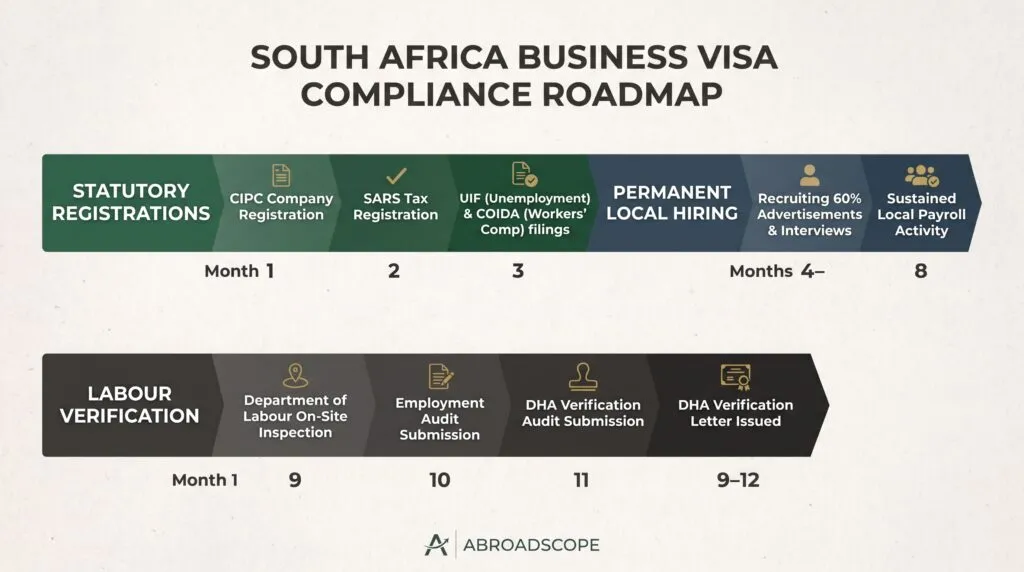
Before DEL will sign off on your 60% staffing compliance, your company must be fully registered and active across South Africa’s statutory framework. If you launched a new business on signed undertakings, convert every single one into live proof of registration within your first 90 days:
- CIPC (Companies and Intellectual Property Commission): Active company registration documents (COR14.3) and up-to-date annual returns.
- SARS (South African Revenue Service): Corporate Income Tax registration, active PAYE (Pay-As-You-Earn) employer registration, and a clean Tax Compliance Status (TCS) PIN.
- UIF (Unemployment Insurance Fund): Employer registration with the Department of Employment and Labour’s uFiling system, with monthly employee declarations and contributions paid up to date.
- COIDA (Compensation Fund): Registration under the Compensation for Occupational Injuries and Diseases Act, along with a valid Letter of Good Standing once assessed.
- Industry or Professional Councils: Proof of registration with any SAQA-recognised professional body, board, or council applicable to your regulated sector.
Common pitfall: Paying South African staff directly via EFT from a personal or offshore account without running a formal South African payroll (PAYE and UIF) makes those hires invisible to DEL inspectors. Every permanent employee must be formally onboarded onto your local payroll from month one.
Step 2: Build Your Audit-Ready Department of Employment and Labour Dossier
When you apply to your provincial DEL office for the Regulation 14(4) confirmation letter—or when a labour inspector visits your premises—you should have a clean, indexed compliance file ready for immediate inspection:
- Company & Visa Basics: Copy of your Business Visa, passport, CIPC registration certificate, and the original 60% undertaking submitted with your visa application.
- Complete Staff Register: A breakdown of every person working in the business, showing full names, job titles, start dates, contract type (permanent vs. fixed-term), and citizenship/residency status.
- Identity & Status Verification: Certified copies of South African green barcoded ID books or Smart ID cards for South African citizens, Permanent Residence certificates for PR holders, and valid work/business visas for every foreign national employed.
- Signed Permanent Employment Contracts: Compliant with the Basic Conditions of Employment Act (BCEA), specifying permanent employment, working hours, leave entitlements, and remuneration meeting or exceeding the National Minimum Wage.
- Payroll & Statutory Proof: Recent payslips, SARS EMP201 monthly employer declarations, UIF monthly declaration schedules showing employee contributions, and your COIDA registration certificate.
Section 38 Employer Reminder: Under Section 38 of the Immigration Act, South African employers carry strict legal liability for verifying the visa status of any foreign national working on their premises and must retain prescribed employment records for at least two years after termination. Never allow a foreign specialist or partner to “help out” informally on a visitor visa while your business is under DEL review.
Step 3: Submit Your DEL Request by Month 9 (Not Month 12)
Do not wait until week 50 of your first year to engage the Department of Employment and Labour. Provincial DEL offices experience significant backlogs, and if an inspector schedules a physical site visit before signing off on your confirmation letter, the process can easily take 6 to 12 weeks.
Follow this practical 12-month execution schedule:
- Months 1–3: Finalise CIPC, SARS (Income Tax + PAYE), UIF, and COIDA registrations and open your South African business bank account.
- Months 4–7: Recruit and onboard permanent South African citizens or permanent residents onto compliant BCEA contracts and monthly PAYE/UIF payroll.
- Months 8–9: Conduct an internal compliance audit and submit your formal request to the Department of Employment and Labour for the Regulation 14(4) confirmation letter.
- Months 10–11: Host any required DEL site inspection, obtain the signed confirmation letter, and submit proof of compliance to the Department of Home Affairs ahead of your 12-month anniversary.
What Happens If You Miss the 60% Quota or 12-Month Deadline?
Failing to meet the 60% local staff requirement—or failing to lodge your DEL confirmation with Home Affairs—does not automatically trigger an immediate deportation notice the next morning. Instead, it creates a ticking compliance time bomb that detonates at two critical junctures:
- Business Visa Renewal (Year 3): A Section 15 Business Visa is issued for up to three years and must be renewed in South Africa at least 60 days before expiry. Both the DTIC and DHA will demand proof that you honoured every condition of your initial grant—including the 60% permanent local staffing ratio, active SARS/UIF/COIDA compliance, and proof that your R5 million investment remains in the business (the separate 24-month requirement). Non-compliance is grounds for outright refusal of your renewal.
- Permanent Residence Eligibility: If your long-term goal is transitioning from a Business Visa to South African Permanent Residence under Section 27(c), any gap in your 12-month DEL compliance or statutory registrations will stall or derail your application.
If genuine commercial delays (such as municipal licensing bottlenecks or supply-chain setbacks) prevent you from hitting the 60% headcount before month 12, do not ignore the deadline. Proactive legal representation—documenting good-faith recruitment efforts and engaging DHA before your renewal window—is vastly more effective than trying to explain a silent breach two years later.
Stay Compliant From Day One to Renewal
Launching a business in a new country is demanding enough without navigating South Africa’s overlapping Home Affairs, SARS, UIF, COIDA, and Department of Employment and Labour rules on your own.
At Abroadscope, we don’t disappear once your Business Visa is approved. We support foreign founders throughout the post-issuance lifecycle—coordinating your statutory registrations, auditing your 60% local staff contracts before DEL submission, securing your Regulation 14(4) confirmation letter, and preparing your file seamlessly for 24-month investment reporting and visa renewal.
Approaching your 12-month Business Visa milestone—or planning your South African hiring structure? Book a confidential compliance review with Abroadscope today to keep your business and residency fully protected.

