
Every week, multinational companies fly foreign executives, regional directors, and technical specialists into Johannesburg or Cape Town on a standard 90-day visa-exempt entry—or a short-term business visitor visa—assuming that because the visitor remains on an overseas payroll, no work authorisation is required.
Under South African immigration law, that assumption is a serious legal trap.
The Immigration Act 13 of 2002 defines “work” so broadly that it routinely catches unpaid, short-term, and offshore-salaried activities performed on South African soil. When a visiting executive crosses the invisible line from attending a board meeting into hands-on operational work, both the individual and the South African host company breach the Act—exposing local directors to criminal prosecution under Section 38 and Section 49(3).
Here is the exact legal boundary between permitted business visits and unauthorised work in South Africa, how the 2026 Electronic Travel Authorisation (ETA) fits in, and how HR teams can protect their organisation from costly compliance failures.

How Does South African Law Define “Work”?
The biggest misconception among international HR teams is tying “work” to local payroll. Many companies assume that if a foreign national is not paid by the South African entity, they are merely a business visitor.
South African law rejects that test entirely. Under Section 1(1) of the Immigration Act, “work” includes conducting any activity normally associated with the running of a specific business, or being employed or conducting activities consistent with being employed or consistent with the profession of the person, with or without remuneration or reward, within the Republic.
In plain terms:
- Unpaid activity still counts as work. A visiting European director who “helps out” operationally for three weeks while the local manager is on leave—without drawing a single Rand from the South African subsidiary—is working illegally.
- Offshore payroll does not exempt you. Remaining on a UK, US, or German employment contract does not convert hands-on technical or managerial work in South Africa into a “business visit.”
Business Meetings vs. “Work”: What Is Permitted on a Visitor Visa?
If your traveller holds a visa-exempt passport (such as the UK, US, EU, or Australia) or obtains a standard short-term Visitor’s Visa (or Electronic Travel Authorisation / ETA), they are strictly limited to passive, non-productive business interactions.
Use this operational boundary table to screen incoming corporate travellers before booking flights:
| Activity Type | Standard Business Visitor Visa / ETA (No Work Permit) | Requires Section 11(2) Short-Term Work Visa (or Long-Term Work Visa) |
| Executive & Governance | Attending board meetings, shareholder meetings, or high-level strategy sessions. | Stepping in as acting GM, signing off on daily operational workflows, or managing local staff. |
| Commercial & Sales | Negotiating or signing commercial contracts, meeting prospective clients, or conducting site visits. | Delivering billable consulting services, executing client deliverables, or running an on-site audit. |
| Events & Conferences | Attending industry conferences, trade shows, or seminars as a delegate. | Performing paid or unpaid hands-on production, technical setup, or commercial event operations. |
| Technical & Engineering | Inspecting a facility to scope a future proposal (hands-off observation only). | Installing, commissioning, repairing, or maintaining machinery, software, or industrial systems. |
| Training | Receiving classroom-style orientation or attending a brief corporate workshop. | Delivering structured technical training, running a systems rollout, or conducting hands-on skills transfer. |
The Golden Rule: If the visitor is discussing, negotiating, or observing business, a standard business visit usually suffices. The moment they start producing, installing, auditing, training, or managing operations on the ground, Section 11(2) short-term work authorisation (up to 90 days) or a long-term work visa is legally mandatory before they board their flight.
Can You Work in South Africa on the 2026 Electronic Travel Authorisation (ETA)?
No. As South Africa rolls out its new Electronic Travel Authorisation (ETA) system across targeted nationalities in 2026 (beginning with travellers from China, India, Indonesia, and Mexico, with further expansion underway), some corporate travellers have mistakenly assumed the digital ETA replaces short-term work visas.
Home Affairs’ position is unambiguous: an ETA is strictly a pre-travel authorisation for tourism and standard business visits. It confers zero right to take up employment or perform hands-on technical work in South Africa. Using an ETA or a visa-exempt 90-day entry to conduct work is a direct contravention of the Immigration Act that jeopardises both the traveller’s current entry and any future South African visa applications.
Section 38 Employer Liability: Why the South African Host Takes the Hit
When a foreign national works without proper authorisation, the legal consequences do not stop with the traveller being declared undesirable or deported. Section 38 of the Immigration Act places a strict, proactive legal duty directly on the South African host employer.
Under Section 38(1), no person or company may employ:
- An illegal foreigner;
- A foreigner whose immigration status does not authorise them to be employed by that entity; or
- A foreigner on terms, conditions, or in a capacity different from those contemplated in their visa.
Three Hidden Traps Inside Section 38
- Ignorance Is Not a Defence (Section 38(2)): Employers have an active legal duty to make a good-faith effort to verify every foreign worker’s passport and visa status before they begin any activity. Claiming you “didn’t know” a visiting consultant only had a tourist stamp will not protect the company.
- The Premises Presumption (Section 38(5)): If an immigration or labour inspector finds an unauthorised foreign national working on your business premises, the law presumes that person is employed by your business unless you can prove otherwise.
- Mandatory Record-Keeping & Reporting (Section 38(4)): Employers must retain prescribed copies of every foreign worker’s passport, visa, and employment records for at least two years after termination, and must report any termination or breach of visa status to Home Affairs.
Criminal Penalties Under Section 49(3)
Knowingly employing—or allowing—a foreign national to work in violation of Section 38 is a criminal offence under Section 49(3) of the Immigration Act:
- First Conviction: A fine or imprisonment for up to one year.
- Second Conviction: A fine or imprisonment for up to two years.
- Third or Subsequent Conviction: Imprisonment for up to five years without the option of a fine.
Courts can also order the non-compliant employer to pay the full costs of the foreign national’s detention and deportation. Furthermore, under South Africa’s Employment Services Act framework, policymakers have pushed for steep escalating administrative fines for repeated non-compliance—making informal “fly-in, fly-out” workarounds an unacceptable boardroom risk.
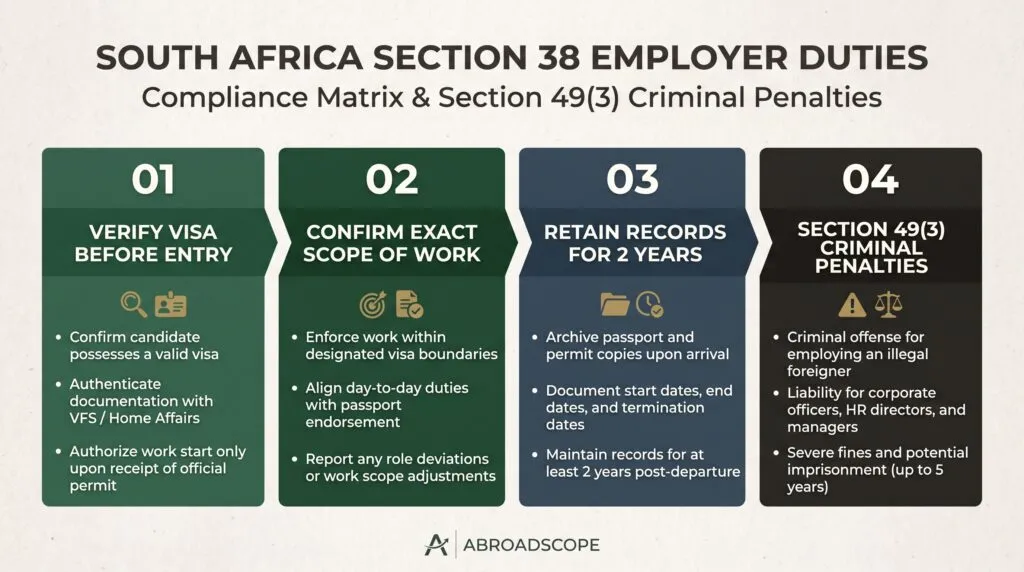
A 4-Step Pre-Travel Compliance Checklist for HR & Mobility Teams
To eliminate Section 38 exposure without slowing down legitimate international business travel, corporate HR and legal teams should embed four quick checks into their travel approval workflow:
- Screen the Activity, Not the Payroll: Before approving any foreign visitor’s flight to South Africa, require a one-paragraph scope of activities. If it involves hands-on delivery, commissioning, auditing, or operational cover, route it to a Section 11(2) application immediately.
- Issue Accurate Invitation Letters: For genuine business visitors (meetings, conferences, contract negotiations), issue a formal South African host invitation letter stating the exact non-work purpose, dates, and confirming that no productive work will be performed.
- Never Convert In-Country: Remind visiting executives that you cannot fly into South Africa on a visitor visa or ETA and “upgrade” to a Section 11(2) or work visa locally. Work authorisation must be secured at the South African Mission abroad before departure.
- Audit Your Premises & Contractors: Ensure your security desk, HR team, and site managers verify the visa conditions of all foreign specialists entering your facilities—including third-party vendor engineers—and keep digital copies on file for two years.
Keep Your Corporate Travel Compliant Without Slowing Down Business
The line between a routine executive visit and illegal work in South Africa is thinner than most multinational companies realise—and with joint Department of Home Affairs and Department of Employment and Labour inspections intensifying, relying on outdated “they’re on foreign payroll” assumptions is no longer viable.
At Abroadscope, we help multinational HR directors, legal teams, and regional headquarters navigate South African corporate mobility with complete certainty. From rapid pre-travel activity assessments and compliant business invitation letters to 5-to-10-day Section 11(2) authorisations and long-term executive work visas, we keep your teams moving and your South African entity fully protected under Section 38.
Unsure whether your incoming executive or specialist needs a Section 11(2) visa? Contact Abroadscope today for a fast, confidential corporate mobility compliance check.

